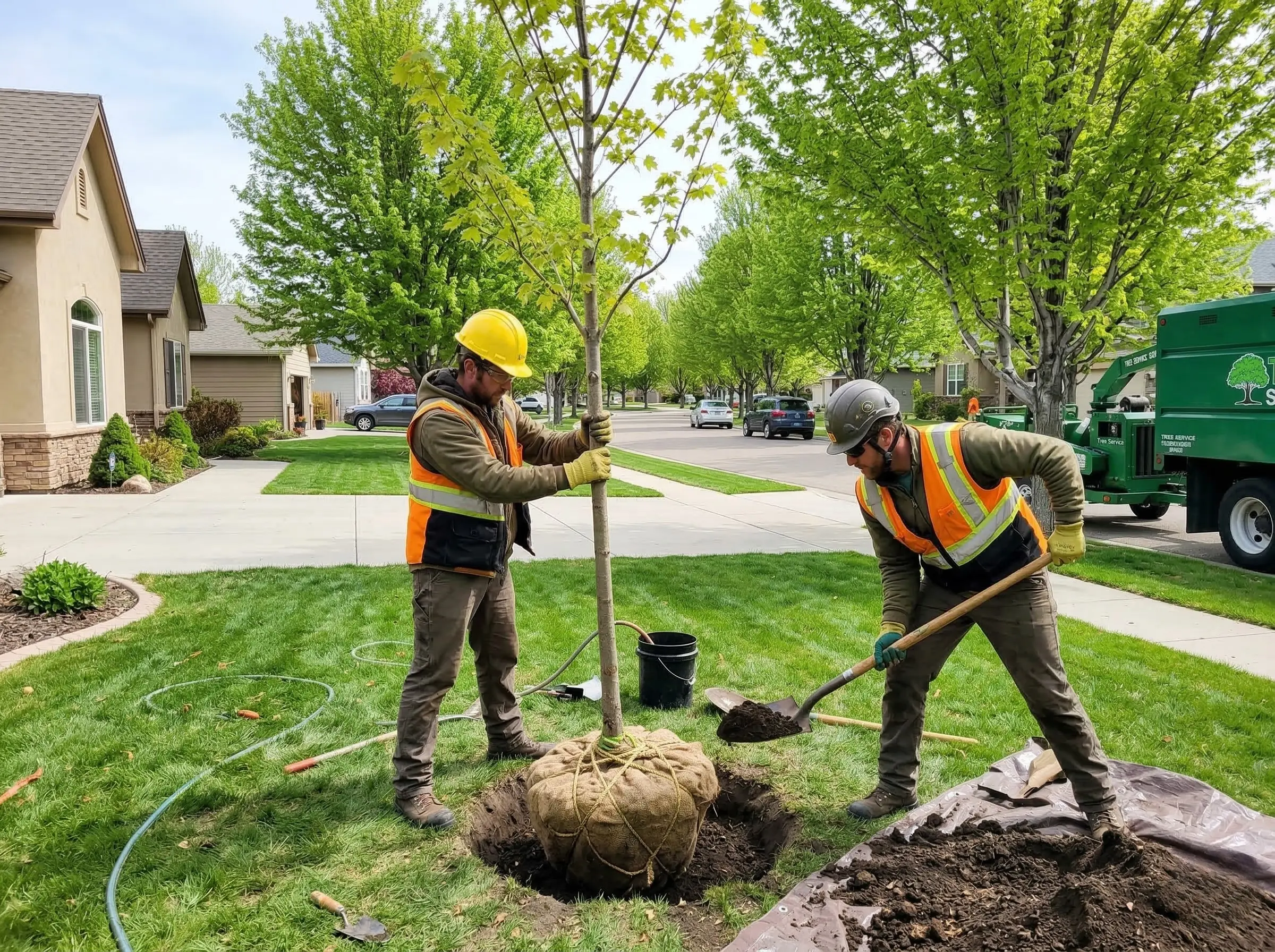
We remove a lot of trees. And about half the time, the homeowner says some version of the same thing: "I wish someone had told me not to plant this here."
The wrong tree in the wrong spot creates problems that take 20 years to show up and cost thousands to fix. A silver maple planted six feet from a foundation. A cottonwood in a small backyard. A red maple struggling in alkaline soil that turns yellow every summer and never looks right.
Choosing the best trees to plant in Boise comes down to understanding three things: our soil (alkaline clay, usually pH 7.5+), our climate (hot dry summers, cold winters, wind), and the space you actually have. Get those three right and the tree basically takes care of itself. Get any of them wrong and you are calling an arborist in 15 years to deal with the consequences.
This guide is written by ISA-certified arborists who've been planting, pruning, and removing trees across the Treasure Valley since 2008. We know what thrives here because we see the results, good and bad, every week.
Need help choosing or planting the right tree? Get a free consultation.
In this article
What Makes Boise Tough on Trees
Before the list, you need to understand why some trees fail here. Boise is not Seattle. It is not Denver. It has its own set of challenges that eliminate a lot of popular nursery trees.
Alkaline soil. Most of the Treasure Valley has soil pH between 7.2 and 8.0. That's too alkaline for many species. Trees that need acidic soil (red maples, pin oaks, sweetgums) develop iron chlorosis here. Their leaves turn yellow between the veins, the tree weakens year after year, and eventually you're paying for removal of a tree that never should have been planted.
We see this constantly in Meridian and Nampa where new subdivisions plant whatever looks good at the nursery without testing the soil.
Hot, dry summers. Boise averages about 12 inches of rain per year, and almost none of it falls between June and September. Trees need irrigation to survive here, but some species handle drought stress much better than others once established.
Wind. Spring windstorms are a fact of life in the Treasure Valley. The December 2025 storm brought gusts near 70 mph and knocked down trees across the valley. Species with brittle wood (cottonwoods, silver maples, Bradford pears) fail in these events. Trees with strong, flexible wood survive.
Cold winters. Boise sits in USDA hardiness zone 6b/7a. That rules out anything subtropical, but it also means you need species that handle the freeze-thaw cycles of our shoulder seasons.
Clay soil and poor drainage. Construction on new lots compacts the soil, and Boise's clay holds water when it rains and bakes hard when it dries. Trees with shallow root systems struggle. Trees that need well-drained soil get root rot.
Quick Comparison: Top Trees for Boise at a Glance
| Tree | Mature Height | Alkaline Soil | Drought | Wind | Best For |
|---|---|---|---|---|---|
| Honeylocust | 40–50 ft | Excellent | Excellent | Excellent | All-around shade |
| Bur Oak | 60–80 ft | Excellent | Excellent | Excellent | Large lots, legacy tree |
| Kentucky Coffeetree | 50–60 ft | Excellent | Good | Good | Medium-large yards |
| Hackberry | 40–60 ft | Excellent | Excellent | Excellent | Low-maintenance shade |
| Japanese Tree Lilac | 20–25 ft | Good | Good | Good | Small yards, flowers |
| Amur Maple | 15–20 ft | Good | Good | Good | Fall color, small spaces |
| Austrian Pine | 40–60 ft | Excellent | Good | Excellent | Screening, windbreak |
| River Birch | 40–50 ft | Fair | Fair | Good | Near water only |
The Best Shade Trees for Boise
These are the workhorses. Big canopy, good structure, long-lived, and proven in Treasure Valley conditions.
Honeylocust (Gleditsia triacanthos var. inermis)
The honeylocust is arguably the single best shade tree for Boise. The 'Shademaster' and 'Skyline' cultivars are thornless, podless, and nearly bulletproof in our conditions. They tolerate alkaline soil, drought, heat, and urban pollution. The dappled shade they cast is light enough that lawn grows underneath, which many homeowners appreciate.
Honeylocusts grow to about 40 to 50 feet with an open, spreading canopy. Their wood is strong and flexible, so they handle Boise's wind far better than silver maples or cottonwoods. Fall color is a clean yellow.
Best for: Front yards, street trees, properties where you want shade without dense canopy.
Bur Oak (Quercus macrocarpa)
If you want a tree your grandchildren will sit under, plant a bur oak. These are massive, long-lived trees (200+ years) that tolerate alkaline soil, drought, wind, and cold. They are slow to establish but nearly indestructible once they get going.
Bur oaks grow 60 to 80 feet tall and wide. That means they need space. Do not plant one 15 feet from your house. But on a larger lot (common in Eagle and parts of south Boise), a bur oak becomes a genuine landmark tree.
Best for: Large lots, long-term shade, properties where you are planting for the next generation.
Kentucky Coffeetree (Gymnocladus dioicus)
The Kentucky coffeetree is underplanted in Boise and deserves more attention. It thrives in alkaline soil, handles drought, and develops a strong structure that resists wind damage. The male cultivar 'Espresso' is seedless, so no messy pods.
It grows 50 to 60 feet with an upright, open habit. Winter interest is excellent because the bold, angular branch structure looks striking against the sky. This tree rarely needs corrective pruning because its natural form is strong.
Best for: Medium to large yards, alkaline soil properties, anyone who wants something different from the usual maple-and-ash lineup.
Hackberry (Celtis occidentalis)
Hackberry isn't glamorous, but it's one of the toughest trees you can plant in the Treasure Valley. It tolerates everything Boise throws at it: alkaline soil, drought, wind, clay, heat, cold. Grows 40 to 60 feet with a rounded canopy and solid shade.
The main knock on hackberry is its rough, warty bark and the small berries it drops in fall. But from an arborist's perspective, it's a tree that thrives with almost zero intervention. We rarely get called to work on hackberries because they just don't cause problems.
Best for: Low-maintenance properties, tough sites, homeowners who want a "plant it and forget it" shade tree.
Best Medium and Small Trees for Boise
Not every lot needs a 60-foot oak. These trees fit smaller yards, work near structures, and still perform well in Boise's conditions.
Japanese Tree Lilac (Syringa reticulata)
Tops out at 20 to 25 feet. Produces large clusters of creamy white flowers in June, after the common lilacs have finished. Tolerates alkaline soil and moderate drought. Strong structure with minimal pruning needs. One of the best small trees for Boise front yards.
Best for: Front yards, small lots, near patios and walkways.
Amur Maple (Acer ginnala)
A small maple (15 to 20 feet) that actually works in Boise's alkaline soil, unlike its red maple cousins. Brilliant fall color (red to orange), multi-stem or single-trunk form, and good drought tolerance once established. Works well as a specimen tree or a screen.
Best for: Accent planting, small spaces, patio areas, properties where you want fall color without the iron chlorosis issues of red maples.
Crabapple (Malus cultivars)
Crabapples are everywhere in Boise, and for good reason. They are tough, they bloom beautifully in spring, and the newer disease-resistant cultivars ('Prairifire,' 'Sugar Tyme,' 'Spring Snow') stay healthy with almost no care.
Pick a cultivar with persistent small fruit (they feed birds in winter) or go with 'Spring Snow' if you want fruitless. Avoid older varieties prone to apple scab. Learn how to prune fruit trees in Boise to keep them healthy and productive. Also check out the diseases to watch for in our tree health guide.
Best for: Front yard color, spring interest, small to medium lots.
Austrian Pine (Pinus nigra)
One of the best evergreen options for Boise. Grows 40 to 60 feet, tolerates alkaline soil, drought, and wind. Provides year-round screening and wind protection. Common as a windbreak tree on agricultural properties in Nampa and Caldwell, but also works well as a specimen in residential yards.
Best for: Windbreaks, screening, year-round green, larger lots.
Trees That Perform Well Along Boise's Waterways
If your property is along the Boise River, an irrigation canal, or in a low area with more moisture, these species work well.
River Birch (Betula nigra)
One of the most popular trees in the Treasure Valley for a reason. River birch handles wet soil, tolerates some alkalinity (though it prefers slightly acidic conditions), grows fast, and has beautiful peeling salmon-colored bark. The 'Heritage' cultivar is the standard choice.
Plant it where it will get consistent water. In drier, fully alkaline sites, it can develop chlorosis, so it is not the right tree for every Boise property. But near water, it excels.
Best for: River-adjacent properties, irrigated landscapes, areas with consistent moisture.
Baldcypress (Taxodium distichum)
A deciduous conifer that sheds its needles in fall. It tolerates wet soil, drought once established, and alkaline conditions. Grows tall (50 to 70 feet) with a narrow, pyramidal form. Unusual and striking. More homeowners in the Treasure Valley are discovering this tree, and we expect to see a lot more of them in the next decade.
Best for: Large properties near water, unique specimen tree, homeowners who want something distinctive.
Trees to Avoid in Boise
This list matters as much as the "plant these" list. We remove these species constantly.
Silver Maple
Fast growing, yes. But silver maples develop included bark, weak branch unions, invasive roots, and brittle wood that fails in storms. They are the number one species we get emergency calls about across the Treasure Valley. If you already have one, cabling and bracing can help. But do not plant a new one.
Bradford/Callery Pear
Beautiful in spring. Structurally terrible. Bradford pears have narrow branch angles that split apart as the tree matures, usually in the 15 to 20-year range. They also spread aggressively as an invasive species. Several states have banned them. Skip it.
Red Maple (Acer rubrum)
Red maples look gorgeous at the nursery. But Boise's alkaline soil makes iron absorption nearly impossible for this species. The result: iron chlorosis that turns the leaves yellow-green every summer. The tree weakens, becomes susceptible to pests, and eventually needs removal.
We see this in neighborhoods across Meridian and Nampa where developers planted rows of red maples without testing the soil.
Cottonwood (Populus species)
Cottonwoods are native and they grow incredibly fast. But they have soft, brittle wood, aggressive root systems that destroy infrastructure, and they drop massive limbs with little warning. They belong along rivers and canals, not in residential yards. If you have a large cottonwood near your home, regular crown thinning is essential for safety.
Lombardy Poplar
Planted as a quick screen, dead within 15 years. Lombardy poplars are extremely susceptible to canker disease in Boise's climate. They look great for a few years, then start dying branch by branch from the top down. By the time you notice, the tree is mostly dead and needs removal.
How to Give Your New Tree the Best Start in Boise
Planting the right species is half the battle. The other half is planting it correctly in Boise's conditions.
Do not amend the planting hole. This is counterintuitive, but filling the hole with rich soil mix creates a "bathtub effect" where roots circle inside the amended zone and never push out into the native clay. Dig a wide, shallow hole (2 to 3 times the root ball width, same depth), plant in native soil, and mulch on top.
Mulch correctly. 2 to 4 inches of wood chip mulch in a ring around the tree, pulled back from the trunk. No mulch volcanoes. Mulch keeps roots cool, retains moisture, and improves soil biology over time.
Water deeply and infrequently. New trees in Boise need deep watering once a week during summer for the first two to three years. Shallow daily watering encourages shallow roots. A slow trickle from a hose for 30 to 45 minutes at the base does more good than a quick sprinkler pass.
Structural pruning in years 3 through 10. This is where most homeowners miss the opportunity. Young tree pruning is cheap ($150 to $300) and prevents the structural defects (included bark, co-dominant stems, crossing branches) that cost thousands to fix later. A single visit from an arborist in your tree's early years can shape its structure for decades.
Need help with tree selection or planting? Our arborists do free on-site consultations. Schedule yours here.
Boise Tree Planting Resources
The City of Boise's Treasure Valley Tree Selection Guide is a solid resource for species recommendations by landscape setting. The Idaho Department of Lands also publishes guidance on matching trees to Idaho conditions.
Local nurseries that stock Boise-appropriate species include Adams Gardens in Nampa and Far West Garden Center in Boise. Both carry the cultivars recommended in this guide.
FAQs: Planting Trees in Boise
When is the best time to plant trees in Boise?
Fall (late September through November) is ideal. The soil is still warm enough for root growth, but air temperatures are cooling down so the tree is not fighting heat stress. Spring planting (March through May) is the second-best window. Avoid planting in summer heat.
How often should I water a newly planted tree in Boise?
Deep water once a week during summer for the first two to three growing seasons. Run a hose at a slow trickle near the base for 30 to 45 minutes. Reduce frequency in spring and fall. In winter, water once a month if there has been no precipitation.
What trees grow fastest in Boise?
Honeylocusts, river birch, and hackberry all grow at a moderate to fast rate (2 to 3 feet per year) while maintaining good structure. Avoid planting trees just for speed. The fastest growers (cottonwood, silver maple, Lombardy poplar) are the ones that cause the most problems.
Can I plant a maple in Boise?
Yes, but choose the right one. Amur maple and sensation maple tolerate Boise's alkaline soil. Red maples, sugar maples, and most Japanese maples struggle with iron chlorosis here. If you want fall color, an Amur maple or a honeylocust gives you the look without the problems.
Do I need an arborist to plant a tree?
Not necessarily. But a quick consultation can save you from planting the wrong species in the wrong spot, which is the single most expensive tree care mistake homeowners make. We provide free on-site consultations where an ISA-certified arborist can recommend species and placement for your specific property. Schedule one here.
How far from my house should I plant a tree?
At minimum, half the mature canopy spread. For a large shade tree (50-foot canopy), plant at least 25 feet from the foundation. For medium trees (30-foot canopy), 15 feet minimum. For small trees (15 to 20 feet), 8 to 10 feet is usually enough. Also consider proximity to sewer lines, power lines, driveways, and neighboring properties.
Pick the Right Tree Now, Skip the Problems Later
The trees you plant today determine the calls you make (or do not make) to an arborist in 20 years. Choose species that match Boise's soil, climate, and your available space.
If you are not sure what to plant or you want a second opinion on what is already in your yard, our arborists are happy to take a look. No charge for the consultation, no sales pitch.
Get Your Free Consultationor call (986) 202-7387