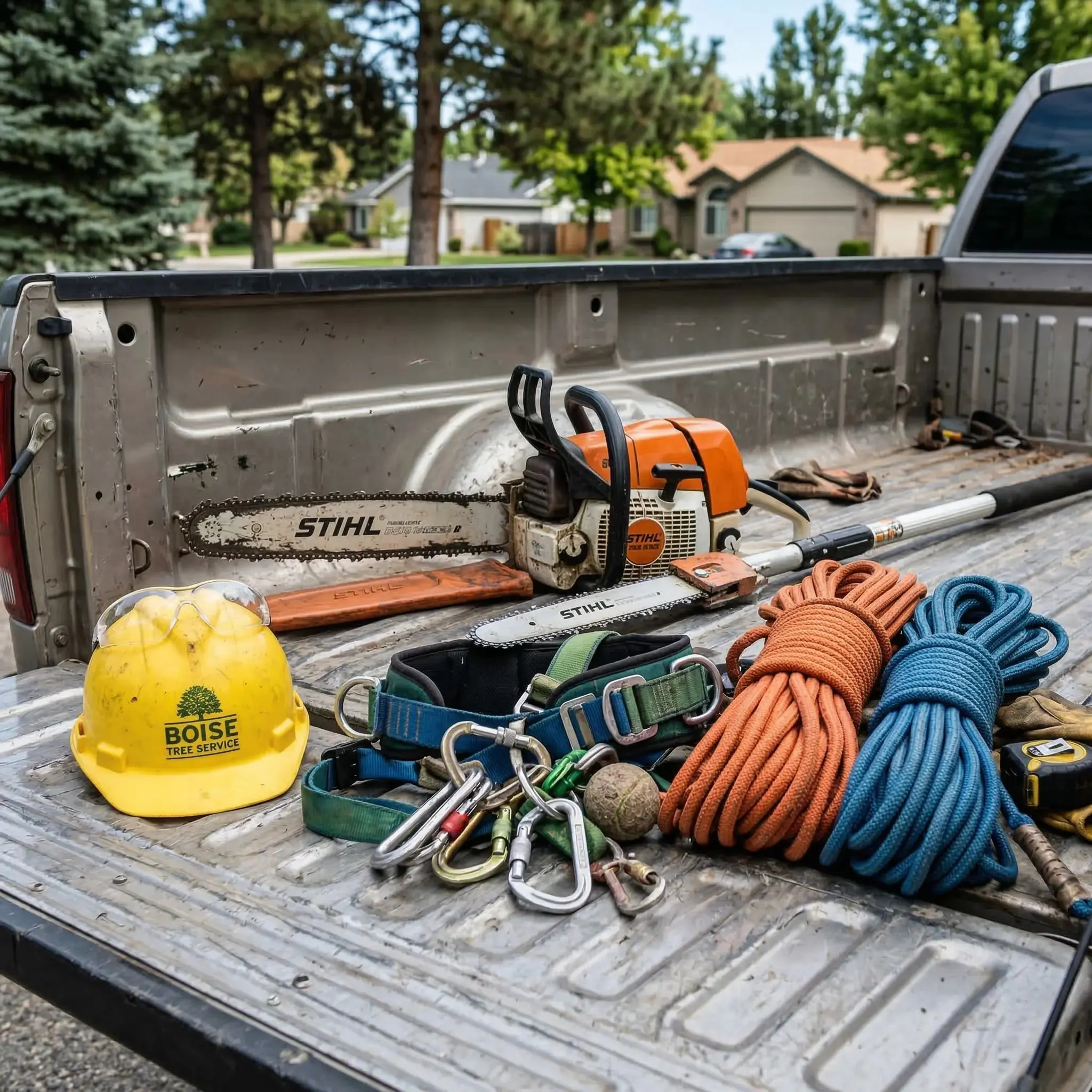
A homeowner in Southeast Boise, Greg, hired the cheapest tree service he could find to remove a dead cottonwood in his backyard. They showed up in a pickup truck, no bucket truck, no chipper. They dropped the main trunk toward the house instead of away from it. The trunk bounced off a stump and took out 20 feet of fence and cracked the neighbor's shed wall. When Greg asked for their insurance information, they stopped returning his calls.
Greg's story isn't unusual. We get calls every month from homeowners dealing with the aftermath of bad tree work: topped trees regrowing into worse shapes, property damage from uncontrolled drops, stumps left behind, and crews that disappeared mid-job.
Hiring a tree service in Boise isn't hard if you know what to look for. This guide covers the questions that matter, the red flags that should make you walk away, and how to compare quotes without getting fooled by the lowest number.
In this article
The Five Things That Actually Matter
1. Insurance (This Is Non-Negotiable)
Ask for a current certificate of insurance showing:
- General liability ($1 million minimum, $2 million is better)
- Workers' compensation covering every crew member
Don't just take their word for it. Ask them to have their insurance company send you the certificate directly, or call the number on the certificate to verify it's active.
Why this matters so much: Tree work is one of the most dangerous jobs in the country. If an uninsured worker falls from your tree and is injured, you could be held liable. If an uninsured crew drops a limb on your neighbor's car, that's on you too. No insurance certificate, no work on your property. Full stop.
We carry $2 million in liability coverage and full workers' compensation on every crew member. We provide certificates on request without hesitation.
2. ISA Certification
ISA certification means the arborist has passed a comprehensive exam covering tree biology, diagnosis, pruning standards, safety, and management through the International Society of Arboriculture. It's the industry standard for competence.
When it matters most: Any job that involves judgment calls about a living tree. Is this tree safe? Which branches should be pruned and which should stay? Can this tree be saved or does it need to come down? Should we cable it or remove it? These decisions require knowledge of tree biology, not just chainsaw skills.
When it matters less: Straightforward removals of clearly dead trees. But even then, an ISA-certified crew is more likely to do the work safely and cleanly.
How to verify: Ask for the arborist's ISA credential number. You can verify it at treesaregood.org/findanarborist.
3. A Real On-Site Estimate
Any company quoting tree work over the phone or from a photo is guessing. Trees have to be assessed in person. The arborist needs to see the tree's size, condition, lean, proximity to structures, access for equipment, and root zone before giving you a real number.
A proper estimate includes:
- Which trees are being worked on (specific identification)
- What work will be done (specific cuts, removal plan, etc.)
- What's included in cleanup (chipping, hauling, stump grinding or not)
- Timeline for the work
- Total cost
If the estimate is vague ("we'll trim your trees, $800"), ask for specifics. What trimming? Which trees? What standard of pruning?
Free estimate? Schedule one here.
4. They Follow ANSI A300 Pruning Standards
ANSI A300 is the industry standard for tree pruning. It defines proper cutting techniques, acceptable pruning types, and limits on how much canopy can be removed. A company that follows ANSI A300 will never top your trees, never lion-tail them, and never remove more than 25% of the canopy in a single session.
You don't need to memorize the standard. Just ask: "Do you follow ANSI A300 pruning standards?" If they don't know what that is, they're not qualified to prune your trees.
5. They Can Explain Why
A good arborist can explain why they're recommending what they're recommending. "This branch has included bark and is likely to fail in a windstorm, so we want to reduce its weight" is a real reason. "It just needs to be cleaned up" is not.
If you ask "why are you recommending removal instead of trimming?" and the answer is vague or just "it's too far gone," push for specifics. What's wrong with the tree? Where's the defect? What's the risk if you don't act?
Arborists who know their craft can point to the specific problems and explain them in plain language. That's what you're paying for: expertise, not just labor.
Red Flags: Walk Away If You See These
They Recommend Topping
Topping is the practice of cutting main branches back to stubs. It's the single most destructive thing you can do to a tree. Topped trees produce fast, weak regrowth that's more vulnerable to failure than the original branches. The tree becomes more dangerous, not less.
Any company that recommends topping doesn't understand tree biology. This is the biggest red flag in tree care and an automatic disqualifier. Read more about why topping is harmful.
They Go Door-to-Door After Storms
Storm chasers show up in Boise after every major wind event, knocking on doors and offering "great deals" on tree work. Many are uninsured, unlicensed, and from out of state. They do the work (badly), collect cash, and leave town.
If someone knocks on your door offering tree service you didn't ask for, be skeptical. Get their insurance certificate. Check their reviews. Call a local company you can verify instead.
They Ask for Full Payment Upfront
A deposit of 10-25% for large jobs is normal. Full payment before work starts is a red flag. Reputable companies invoice after the work is completed and the site is cleaned up.
They Can't Show Insurance
No certificate of insurance, no exceptions. If they say "we're insured" but can't produce a certificate, treat it as uninsured. The risk to you is too high.
They Don't Do a Site Visit
Phone quotes are guesses. Photo quotes are slightly better guesses. Neither replaces an arborist standing in your yard, looking at your tree, and assessing the real conditions.
They Pressure You to Decide Immediately
"This price is only good today" is a sales tactic. A legitimate estimate stands for at least 30 days. Take your time, compare quotes, and make an informed decision.
How to Compare Quotes (It's Not Just Price)
When you get two or three quotes (which you should for jobs over $1,000), compare them on these dimensions. For a breakdown of what to expect on pricing, see our cost guide.
| What to Compare | Good Sign | Bad Sign |
|---|---|---|
| Scope of work | Specific trees, specific cuts described | Vague "trim and clean up" |
| Cleanup | Chipping, hauling, site cleanup included | "We'll leave the wood for you" |
| Insurance | Certificate provided proactively | "Yeah we're insured" with no proof |
| Credentials | ISA-certified arborist on assessment | No certifications mentioned |
| Pruning approach | Crown thinning, deadwood, weight reduction | "We'll take the top off" |
| Stump grinding | Included or quoted separately with specifics | Not mentioned at all |
| Timeline | Specific scheduling commitment | "We'll get to it when we can" |
The Cheapest Quote Isn't Always the Best Value
If one quote is dramatically lower than the others, ask why. Common reasons the price is low:
- They plan to top instead of properly prune
- They're not insured (lower overhead, higher risk to you)
- Cleanup isn't included
- They'll use a less experienced crew
- They're underbidding to win the job and will cut corners
Questions to Ask Before Hiring
Use this checklist when talking to tree service companies:
Insurance and credentials:
- Can you provide a certificate of insurance (liability + workers' comp)?
- Is your estimating arborist ISA-certified? What's their credential number?
- How long have you been operating in the Boise area?
Scope and approach:
- Can you walk me through exactly what work you're recommending and why?
- Do you follow ANSI A300 pruning standards?
- How much of the canopy will you remove?
- Do you top trees? (If yes, end the conversation.)
Logistics:
- Is cleanup and debris removal included in the price?
- What about stump grinding?
- When can you schedule the work?
- What's the payment structure?
References:
- Can you provide references from recent Boise jobs?
- Do you have online reviews I can check?
You don't need to ask every question. But the insurance and topping questions are mandatory. Those two alone filter out most of the bad operators. If the job involves tree removal, also ask about permit requirements in Boise.
Arborist vs. Tree Service: What's the Difference?
People use these terms interchangeably, but there's a real distinction.
A "tree service" is any company that does tree work. Some are excellent. Some are a guy with a chainsaw and a truck. The term tells you nothing about qualifications.
An "arborist" is a professional trained in tree biology, health, and management. An ISA-certified arborist has passed a standardized exam proving competence. They can diagnose diseases, assess structural risks, recommend appropriate treatments, and make informed pruning decisions based on tree biology.
The practical difference: For simple, straightforward removals of dead trees, any competent, insured tree service can do the work safely. For anything involving living trees (pruning, health assessment, preservation decisions, cabling and bracing), you want an ISA-certified arborist making the decisions.
How to Find Reputable Tree Services in Boise
ISA's Find an Arborist tool: treesaregood.org/findanarborist lets you search by zip code.
City of Boise's list: The City of Boise maintains a list of licensed tree service providers. Companies on this list have met the city's licensing requirements.
Google reviews: Read recent reviews, not just the star rating. Look for reviews that mention specific work done, crew professionalism, and cleanup quality.
Ask your neighbors. In established Boise neighborhoods (North End, East End, Southeast), homeowners talk to each other about who does good tree work. Word of mouth is still one of the most reliable sources.
FAQs: Hiring a Tree Service in Boise
How many quotes should I get?
Two or three for jobs over $1,000. For smaller jobs ($200-$500), one quote from a company you trust is usually sufficient. More than three quotes wastes everyone's time and doesn't give you meaningfully more information.
Does the City of Boise require tree service companies to be licensed?
Yes, for work on public trees (in the right-of-way). The city requires that at least one person in a supervisory role be ISA-certified. For work on private property, there's no city licensing requirement, which is why verifying credentials yourself matters.
What should I do if a tree service damages my property?
Document the damage with photos immediately. Contact the company and request their insurance information. File a claim against their general liability policy. If they're uninsured, you may need to pursue them through small claims court or your own homeowners insurance. This is why hiring insured companies is so critical.
Can I do tree work myself?
Small jobs, yes. Pruning branches you can reach from the ground with a hand pruner or pole saw is generally safe. Anything involving a ladder, a chainsaw, or branches that could hit a structure should be done by a professional. Tree work is one of the most dangerous home maintenance activities. The cost of professional work is almost always less than the cost of a trip to the ER or a damaged roof.
How do I know if my tree needs an arborist or just a tree service?
If the tree is dead and needs to come down, a competent insured tree service is fine. If the tree is alive and you need someone to decide what to prune, whether it's safe, or whether it can be saved, you want an ISA-certified arborist. When in doubt, start with an arborist. They can always do the labor too, but a laborer can't do the assessment.
Hire Right the First Time
Bad tree work costs more than good tree work. It just takes longer to show up on the bill: regrowth that needs re-pruning, storm damage from weakened structure, property damage from uninsured crews, and trees that die from improper cuts.
Get insurance, get credentials, get a real on-site estimate, and get someone who can explain what they're doing and why. That's the whole checklist.
Ready to Hire the Right Tree Service?
ISA-certified arborists. $2 million in liability coverage. Free on-site estimates.
Get insurance, get credentials, get a real estimate. We check every box.
Get Your Free Estimateor call (986) 202-7387