
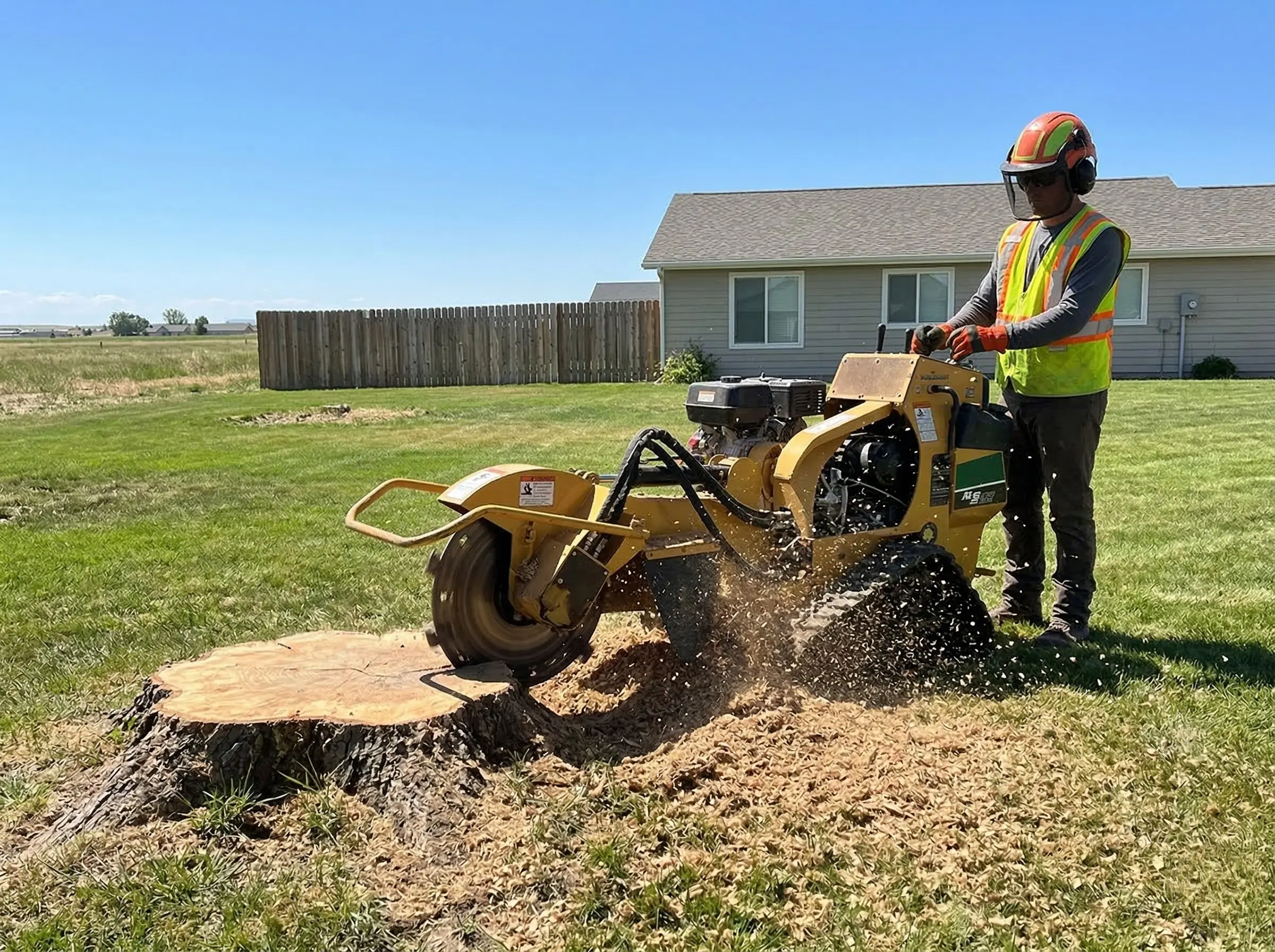
You finally got that dead cottonwood removed from your backyard. The crew was great, the cleanup was solid, and your yard looks better already.
Then you look at the stump.
It's sitting there like a wooden parking bollard in the middle of your lawn. Too short to be useful, too big to ignore. You mow around it. You trip over it. Your kid uses it as a launchpad and you're waiting for the ER visit.
If you're searching for stump grinding in Boise, Idaho, you're probably at this exact stage. Most homeowners don't think about the stump until they've been staring at it for six months. By then, it's usually growing mushrooms and attracting carpenter ants. At Boise Tree Pros, we grind stumps across the Treasure Valley every week, and the process is faster and cheaper than most people expect.
What Is Stump Grinding, Exactly?
Stump grinding is the process of using a machine with a rotating carbide-tipped wheel to chew a tree stump down below ground level, turning it into wood chips. The grinder shaves the wood down in layers, removing the visible stump and its surface roots. It's the most common stump removal method for residential properties in Boise and across the Treasure Valley.
Most stump grinding in Boise goes 6 to 12 inches below ground level. That's deep enough to plant grass over, lay sod, or cover with mulch. If you're planning to plant a new tree in the same spot, you'll want to go deeper — closer to 12 to 16 inches — and clear out more of the chip material. Check our guide on what to plant after stump grinding for the best species options.
What grinding does:
- Removes the visible stump below grade
- Chases surface roots within a couple feet of the stump
- Produces a pile of wood chips (roughly 2 to 3 times the volume of the original stump)
- Takes 30 minutes to 2 hours per stump, depending on size
What grinding doesn't do:
- Remove the root system underground
- Prevent all future sprout growth (some species are stubborn)
- Remove rocks or concrete near the stump
The roots left behind after grinding break down naturally over several years. In Boise's climate, most root systems decompose within 3 to 7 years depending on the species.
How Much Does Stump Grinding Cost in Boise?
Straight talk: stump grinding is one of the more affordable tree services. For a full pricing breakdown, see our stump grinding costs in Boise guide. Most homeowners in the Treasure Valley pay between $75 and $400 per stump, depending on size and access.
Stump grinding cost in Boise by size (2026):
| Stump Diameter | Typical Cost | Notes |
|---|---|---|
| Small (under 12") | $75–$150 | Quick job, usually under 30 minutes |
| Medium (12–24") | $150–$300 | Most common residential stump size |
| Large (24–36") | $250–$400 | Takes longer, more chip volume |
| Extra large (36"+) | $400–$600+ | Big cottonwoods, old-growth maples |
| Multiple stumps | Discounted | Most companies offer per-stump discounts for 3+ |
What affects the price:
- Stump diameter. This is the biggest factor. A 10-inch ornamental stump is a 20-minute job. A 40-inch cottonwood stump is a different story.
- Access. Can the grinder get to the stump easily? If it's behind a fence, between structures, or on a slope, expect to pay more.
- Root grinding. Most companies include surface roots within 2 feet of the stump. If you want roots chased further out, that adds time and cost.
- Depth. Standard depth is 6 to 8 inches below grade. Going deeper for replanting costs more.
- Cleanup. Some companies leave the chips. Others haul them away and backfill the hole. Ask what's included.
Real example: Karen in the North End had three elm stumps, all between 14 and 20 inches across. Open yard, easy access, standard depth. Total cost: $375. That's about $125 per stump with the multi-stump discount. She kept the chips for mulch in her garden beds.
Compare that to a single 36-inch cottonwood stump wedged between a fence and a shed in a backyard off Overland Road. Limited access meant a smaller machine and more time. That one stump ran $450.
When stump grinding is bundled with removal: If you're already having a tree removal before grinding, ask for stump grinding in the same visit. Many Boise tree removal companies offer a bundled price that's cheaper than scheduling grinding separately. You'll typically save $50 to $150 by combining the work.
Stump Grinding vs. Stump Removal: Which Do You Need?
This is the question we get more than any other. Most of the time, grinding is the right answer. But not always.
Stump grinding:
- Grinds the stump 6 to 12 inches below ground
- Leaves the root system intact underground
- Roots decompose naturally over 3 to 7 years
- Less invasive, less expensive, faster
- Best for: lawns, landscaping, most residential situations
Full stump removal:
- Pulls or digs out the entire stump and root ball
- Leaves a large hole that needs backfilling
- More expensive ($250 to $600+, depending on size)
- Tears up surrounding landscape
- Best for: new construction, hardscaping, planting in exact same spot
Choose grinding if: you just want the stump gone and plan to plant grass, mulch, or a garden bed — or you want the cheapest, fastest option and don't have plans to dig in that exact spot.
Choose removal if: you're pouring a foundation, patio, or driveway over the area, or the roots are causing issues with sidewalks, foundations, or underground pipes.
The hybrid approach: Greg, a homeowner in Meridian, wanted to put a paver patio where a 30-inch pine stump sat. Standard grinding wouldn't cut it since he needed the roots out to set a proper base. But full removal would have torn up half his yard. The solution: deep grinding (16 inches below grade) combined with selective root cutting along the patio footprint. Cost him about $100 more than standard grinding, saved him $300 compared to full extraction, and his patio has held up fine for two years.
The Stump Grinding Process: What to Expect
Before the Crew Arrives
Utility locates. Any reputable stump grinding service will call 811 (Idaho Utility Coordinating Council) before grinding. Underground utilities, gas lines, irrigation pipes, and fiber optic cables can all run near stumps. This call is free and required. If a company skips this step, that's a red flag.
Clear the area. Move anything within 10 to 15 feet of the stump. Potted plants, lawn furniture, garden hoses, decorations. The machine throws chips and debris, and you don't want your stuff in the blast zone.
Mark concerns. If you have sprinkler heads, buried dog fences, landscape lighting, or anything underground near the stump, point it out before work starts.
During Grinding
The operator positions the grinder and works the cutting wheel back and forth across the stump, shaving off a few inches at a time. The machine moves side to side and gradually works deeper.
What you'll notice:
- Noise. Stump grinders are loud, roughly on par with a chainsaw. The job is usually short enough that neighbors don't mind, but give them a heads-up if it's early morning.
- Chips flying. The machine throws wood chips in an arc. Most operators set up a barrier or use the machine's built-in guard. Stay back 20 feet.
- Dust and debris. Dry stumps produce more dust. Fresh stumps produce wetter chips. Either way, it's messy in the moment and easy to clean up after.
A typical residential stump takes 30 to 90 minutes. Small stumps under 12 inches can be done in 15 to 20 minutes. A 40-inch cottonwood? Closer to 2 hours.
After Grinding
You're left with a hole filled with wood chips, roughly the shape of the original stump but wider and deeper. The chip pile is usually 2 to 3 times the volume of the stump itself.
Your options:
- Leave the chips and backfill. Rake the chips level, top with 2 to 3 inches of topsoil, and seed grass over it. The chips will decompose underneath. This is the most common approach.
- Remove chips and backfill with topsoil. Cleaner finish, especially if you're laying sod.
- Use chips as mulch. Free mulch for garden beds, tree rings, or pathways. Just don't pile them against tree trunks or siding.
What Happens to the Roots After Grinding?
This worries people more than it should. The roots are still down there, yes. But without a living stump sending signals to grow, the root system slowly dies and decomposes.
Timeline for root decomposition in Boise's climate:
- Softwoods (pine, spruce, cottonwood): 2 to 4 years
- Hardwoods (maple, oak, elm): 4 to 7 years
- Locust: 5 to 8 years (dense, rot-resistant wood)
In most cases, dead roots don't cause problems. Dead roots don't grow. They don't seek out pipes. They don't heave sidewalks. They just quietly rot underground.
Two exceptions to watch for:
- Sprouting. Some tree species try to regrow from the roots even after grinding. Cottonwoods, elms, and tree-of-heaven are the worst offenders in the Treasure Valley. If you see shoots popping up, cut them flush and apply a brush killer to the cut. Most stop after a season or two.
- Settling. As the underground roots and buried wood chips decompose, the ground above can settle slightly. You might notice a shallow dip after a year or two. Top it off with soil and reseed — normal and easy to fix.
Can You DIY Stump Grinding?
Technically, yes. Realistically, it depends.
Renting a stump grinder in Boise runs $200 to $400 per day from equipment rental companies. The machines available for homeowner rental are smaller than professional units, which means more time on bigger stumps.
DIY makes sense if: you have multiple small stumps (under 12 inches) and a full day to work, stumps are in open flat areas with easy access, you're comfortable operating heavy equipment, and you've called 811 for utility locates.
Hire a pro if: you have stumps over 18 inches, stumps are near structures or utilities, access is tight, or you have one or two stumps (the rental cost is close to professional pricing anyway).
The math on DIY: Dan in Eagle rented a grinder for $275 for one day to tackle two 18-inch stumps. After pickup, transport, grinding, cleanup, and return, he spent about 6 hours and went through a set of teeth ($85 replacement). Total: $360. A professional quote for both stumps was $325. He did the work himself and paid more.
Safety note: Stump grinders throw debris at high velocity. Eye protection, ear protection, heavy boots, and long pants are non-negotiable. Keep everyone — especially kids and pets — well clear of the work area.
When You Can Skip Stump Grinding
Not every stump needs to be ground. Some situations where leaving it alone is fine:
- Wooded lots or rural properties. If the stump is out of the way and not in a maintained area, let it decompose naturally. It becomes habitat for insects and fungi that feed woodpeckers and other wildlife.
- Decorative use. A flat-topped stump at the right height makes a solid plant stand or birdbath base.
- Natural decomposition. A stump left alone in Boise's climate will break down in 5 to 10 years. Drill holes, fill with nitrogen-rich fertilizer, and keep it moist to speed it up.
When you shouldn't skip grinding:
- The stump is in your lawn and you're mowing around it
- It's a tripping hazard near walkways or play areas
- Carpenter ants or termites are moving in — if the stump was left after storm damage, pest activity often starts within months
- You're selling the property (stumps look neglected and hurt curb appeal)
- The tree species is prone to root sprouting and suckers are popping up everywhere
Stump Grinding and Tree Planting: What Boise Homeowners Should Know
Planning to plant a new tree where the old one stood? Here's what you need to know.
You can plant near a ground stump, but not right on top of it. The buried wood chips and decaying roots create a nitrogen-poor zone as soil microbes break down the wood. A new tree planted directly in that spot will struggle for nutrients and root space.
Best practice:
- Wait 1 to 2 years after grinding before planting in the same spot
- Remove as many chips as possible and replace with quality topsoil
- Or plant the new tree 3 to 5 feet away from the original stump location
Good replacement trees for the Treasure Valley:
- Bur oak (drought-tolerant, long-lived)
- Honeylocust (filtered shade, adapts well)
- Colorado blue spruce (evergreen, classic Idaho look)
- Red maple (fall color, moderate size)
Talk to a certified arborist before choosing a replacement. The right tree in the right spot saves you headaches for the next 50 years. And if the old tree needed trimming that got out of hand, pick a species that fits the space so you're not back in the same cycle.
FAQs: Stump Grinding in Boise
How much does stump grinding cost in Boise?
Most residential stumps cost $75 to $400, depending on diameter. Small stumps (under 12 inches) run $75 to $150. Large stumps (24 inches+) run $250 to $600+. Multi-stump jobs are usually discounted.
How deep does stump grinding go?
Standard depth is 6 to 8 inches below ground level — enough for grass or landscaping. Deeper grinding (12 to 16 inches) is available for replanting or construction and costs more.
Is it better to grind a stump or remove it?
Grinding is better for most homeowners. It's faster, cheaper, and less invasive. Full removal only makes sense if you're doing construction over the spot or need to plant a new tree in the exact same location.
Can I leave a tree stump in the ground?
You can, but there are trade-offs. Stumps attract insects, create tripping hazards, and can send up sprouts. In maintained yards, grinding is worth the investment.
How long does stump grinding take?
Fifteen minutes to 2 hours per stump. Most average-sized residential stumps are done in under an hour.
Can you plant a new tree after stump grinding?
Yes, but wait 1 to 2 years and clear out the old chips first. Or plant the new tree a few feet away from the original spot for better results.
Do the roots die after grinding?
Yes. Without the stump feeding them, roots die and decompose over 2 to 7 years depending on species. Some trees (cottonwood, elm) may send up sprouts from roots during the first year or two.
Ready to Get Rid of That Stump?
Key takeaways:
- Stump grinding in Boise costs $75 to $400 per stump, depending on size and access
- Grinding is faster, cheaper, and less invasive than full stump removal
- The roots decompose naturally over 2 to 7 years and rarely cause problems
- DIY rental math usually doesn't beat professional pricing for 1 to 2 stumps
- Wait 1 to 2 years before planting a new tree in the same spot