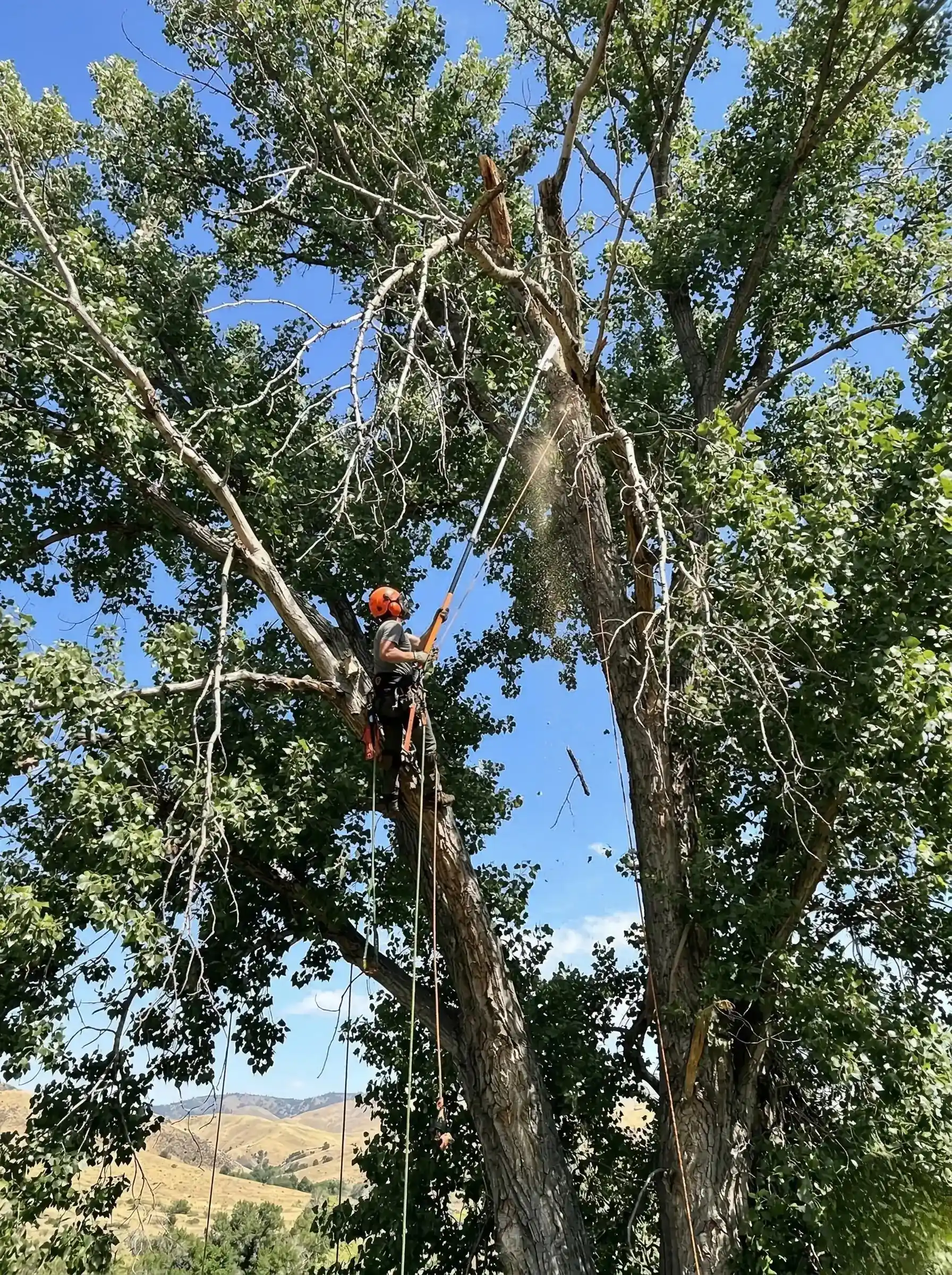
That massive silver maple in your front yard has been there longer than you have. It shades the whole driveway, bumps your property value, and drops enough leaves every October to keep the neighborhood kids busy.
But last spring you noticed something. The two main trunks are pulling apart. There's a crack forming right where they meet, and every time the wind picks up, both sides sway in opposite directions.
You don't want to lose that tree. And you probably don't have to. Tree cabling and bracing in Boise is how ISA-certified arborists stabilize structurally compromised trees without removing them. At Boise Tree Pros, we install support systems on trees across the Treasure Valley every season, and the right setup can add decades of safe life to a tree that would otherwise need to come down.
This guide covers what cabling and bracing actually are, what they cost in Boise, which trees need them, and how to tell whether support is worth it or whether removal is the smarter call.
In this article
What Is Tree Cabling and Bracing?
Tree cabling is the installation of flexible steel or synthetic cables high in a tree's canopy to limit how far branches or leaders can move apart, reducing the risk of structural failure. Bracing uses rigid steel rods bolted through the trunk or branch union to reinforce a weak connection point. Both are supplemental support systems defined under ANSI A300 Part 3, the industry standard for structural tree support.
Think of it this way: cabling is a seatbelt. It lets the tree move naturally but catches it before movement becomes failure. Bracing is a splint. It holds a weak point rigid so it can't split further.
Cabling is used for:
- Co-dominant leaders (two main trunks growing from the same point)
- Heavy lateral branches that extend too far from the trunk
- Preventative support on healthy trees with known weak structure
Bracing is used for:
- Existing cracks or splits in the trunk or major branch unions
- V-shaped crotches with included bark (bark trapped inside the union, preventing wood from fusing)
- Reinforcing a connection that has already started to fail
Both together when a tree has a splitting crotch that also needs movement limitation above the split. This combination is common on large silver maples and cottonwoods in the Treasure Valley.
Want a professional to assess your tree's structure? Request a free estimate and we'll tell you whether support, pruning, or tree removal makes the most sense.
How Much Does Tree Cabling and Bracing Cost in Boise?
When it comes to tree cabling Boise homeowners typically pay between $200 and $900 per tree, depending on the type of system, tree size, and complexity. For a broader look at cabling and bracing costs alongside other tree services, see our pricing guide.
Tree cabling and bracing cost in Boise by type (2026):
| System Type | Typical Cost | Best For |
|---|---|---|
| Single cable (direct) | $200–$400 | Two co-dominant leaders, one attachment point |
| Multiple cables (triangular/box) | $400–$700 | Three or more leaders needing interconnected support |
| Dynamic cable system (Cobra) | $300–$600 | Trees needing flexible, non-invasive support |
| Bracing rods | $500–$900 | Cracked or splitting trunk unions |
| Combined cabling + bracing | $700–$1,200+ | Complex structural failures |
What drives the price:
- Tree size and height. A 30-foot ornamental maple is a different job than a 70-foot cottonwood. Taller trees require more climbing time and longer cables.
- Number of attachment points. A single cable between two leaders is the simplest setup. A box pattern connecting four leaders with multiple cables takes significantly more time and hardware.
- System type. Traditional steel cables cost less upfront but require lag hardware drilled into the wood. Dynamic systems like Cobra use synthetic straps that don't penetrate the tree, but cost more per installation.
- Access and complexity. Tight spaces between structures, proximity to power lines, or decayed wood at attachment points all add difficulty and cost.
- Assessment included. Some arborists charge separately for the initial structural assessment. At Boise Tree Pros, the assessment is part of our free estimate.
Which Boise Trees Need Cabling and Bracing Most?
Certain tree species are structurally prone to the kinds of failures that tree support systems Boise arborists see most often. If you have any of these in your yard, it's worth having a pro check the branch structure.
Silver Maple
The most common candidate for cabling in Boise. Silver maples grow fast, develop multiple competing leaders, and form included bark at branch unions more than almost any other species. That included bark creates a weak point where the wood never fully fuses. Add a Boise windstorm or heavy wet snow, and one side comes down.
Cottonwood
Boise's cottonwoods get massive, and their wood is brittle. They're prone to bacterial wetwood (slime flux), which creates internal pressure that can reach 60 psi, enough to crack the trunk from the inside. Cabling the main leaders is often the only way to keep a large cottonwood standing safely without removing major sections of canopy.
Elm
Siberian elms are everywhere in the Treasure Valley, and they are short-lived trees that develop weak structure quickly. American elms are more stable structurally but still prone to Dutch Elm Disease, which weakens the wood and makes branch failure more likely. Both types benefit from structural pruning combined with cabling.
Ash
Ash trees in Boise, Idaho face a growing threat from wood-boring beetles, and the emerald ash borer is expected to reach Idaho in coming years. Tree bracing Boise Idaho arborists perform on ash trees can buy time while the canopy is still healthy. Beetle damage weakens the vascular system, which compromises structural integrity. Cabling can buy time for ash trees that still have strong root systems and canopy health.
Other Species
Sycamores, Norway maples, and ornamental pears all develop structural issues that can warrant support. The deciding factor is usually the branch architecture, not the species alone. A well-structured cottonwood may never need cabling, while a poorly formed oak might.
If your tree shows signs of structural stress, a tree health assessment can identify whether the issue is structural, disease-related, or both.
The Cabling and Bracing Process in Boise: What to Expect
Step 1: Structural Assessment
Before any hardware goes into the tree, an arborist inspects the entire structure. That means looking at branch unions, checking for included bark, measuring lean angles, assessing root stability, and identifying decay or cavities.
The assessment determines what type of support system the tree needs. Sometimes it determines that support isn't the right approach at all.
This isn't a five-minute glance. A thorough structural assessment on a large tree takes 30 to 60 minutes, sometimes longer if the arborist needs to climb to inspect upper unions.
Step 2: System Design
Based on the assessment, the arborist selects the system type:
- Direct cable: Single cable between two tree parts. Most common for residential trees with two co-dominant leaders.
- Triangular cable: Connects three branches or leaders in a triangle pattern. Used when three or more attachment points need support.
- Box cable: Four or more leaders connected in a closed loop. Typically for large, multi-trunk trees.
- Hub and spoke: A central hub with cables radiating to three or more leaders. Less common in residential work.
Cables are placed at two-thirds the distance between the weak union and the top of the crown, per International Society of Arboriculture (ISA) guidelines. This placement gives enough leverage to limit movement without creating a rigid point that transfers stress elsewhere.
Step 3: Installation
The arborist climbs or uses a lift to reach the attachment points. For traditional steel cable systems, this involves:
- Drilling through the trunk or branch at each attachment point
- Installing a lag eye bolt or J-hook through the drilled hole
- Running the cable between attachment points
- Tensioning the cable to allow natural movement while limiting dangerous range of motion
- Securing all hardware
For dynamic systems like Cobra, no drilling is required. Synthetic straps wrap around the branches and connect with a shock-absorbing cable that allows more natural movement.
Bracing rods are installed by drilling completely through the trunk or branch union, inserting a threaded steel rod, and securing with washers and nuts on both sides.
Installation time: 1 to 3 hours for most residential trees. Complex multi-cable systems on large trees can take a full day.
Step 4: Follow-Up Pruning
Cabling and bracing almost always include some structural pruning. Reducing end weight on supported branches decreases the load on the cables and extends the system's effective life. This combination, structural pruning plus support hardware, is the standard approach recommended under ANSI A300 Part 3.
Cabling and Bracing vs. Tree Removal: How to Decide
This is the real question most homeowners face. Cabling saves the tree. Removal eliminates the problem permanently. Here's how to think through it.
Cabling and bracing make sense when:
- The tree is healthy overall, with the structural defect being the primary concern
- The tree provides significant value (shade, property value, aesthetics, screening)
- The defect can be stabilized effectively (clean unions, minimal decay at attachment points)
- The tree has at least 10 to 20 more years of healthy life ahead of it
- Removal cost would be significantly higher than support
- After removal you'd still need stump grinding, adding to the total expense
Removal makes more sense when:
- The tree is already in decline from disease, pest damage, or root failure
- Decay at the attachment points means hardware won't hold securely
- The tree is a species with a short remaining lifespan regardless of support
- The structural defect is too severe, such as a trunk split below the first branch union
- The tree is in a high-target zone (directly over a house, play area, or parking) and the risk tolerance is low
The bottom line: If the tree is healthy and the defect is manageable, support almost always costs less than removal and preserves something that took decades to grow. If the tree is compromised from multiple angles, support becomes a temporary fix on a permanent problem. Understanding the difference between structural defects vs disease is key to making the right call.
Not sure which category your tree falls into? Get a free structural assessment from our ISA-certified arborists.
Maintenance: How Long Do Cables and Braces Last?
Tree support systems aren't install-and-forget. The tree keeps growing, and the hardware needs to keep up.
Lifespan by system type:
| System | Expected Lifespan | Notes |
|---|---|---|
| Steel cables | 15–25+ years | Can last up to 40 years with proper maintenance |
| Dynamic (Cobra) systems | 10–15 years | Manufacturer recommends replacement around 12 years |
| Bracing rods | Permanent | The tree grows around them; rods rarely need replacement |
Inspection schedule:
- Annually: Visual inspection from the ground. Look for cable sag, hardware pulling through bark, or new cracks developing.
- Every 3 to 5 years: Close inspection by a climbing arborist. This checks hardware integrity, cable tension, and whether the tree's growth has shifted loads in ways that require adjustment.
- After any major storm: If Boise gets hit with high winds, heavy wet snow, or ice, have the system checked. Storm forces can exceed what the system was designed for, and catching a problem the next day is cheaper than dealing with a failure the next month.
Boise-specific maintenance note: Our climate puts extra stress on support systems. Summer temperatures above 100 degrees expand metal. Winter drops below zero contract it. Wet spring snow loads differently than dry winter snow.
The temperature swings in the Treasure Valley mean annual inspections are more important here than in milder climates. If you're already having regular tree maintenance done, ask your arborist to check the cables while they're in the canopy.
Can You DIY Tree Cabling?
Short answer: no.
Longer answer: hardware store turnbuckles and aircraft cable are not rated or designed for tree support. Improper placement creates false security. A cable in the wrong position can actually increase the risk of failure by creating a stress concentration point.
Drilling into a tree without understanding where decay is present can weaken the attachment point. And if an improperly cabled tree fails and damages your neighbor's property, your homeowner's insurance may not cover it.
Tree cabling and bracing should only be performed by ISA-certified arborists trained in supplemental support systems. Learn why ISA certification matters for cabling and how to vet your provider. If you're searching for an arborist cabling service Treasure Valley residents trust, make sure they're ISA-certified and ANSI A300 compliant. This is one area where the stakes, literally, are too high for DIY.
FAQs: Tree Cabling and Bracing in Boise
How much does tree cabling cost in Boise?
For tree cabling Boise residents can expect to pay $200 to $700 per tree. Bracing runs $500 to $900. Combined systems can reach $1,200 or more for complex jobs. The main cost drivers are tree size, number of attachment points, and system type.
Does cabling hurt the tree?
Traditional steel systems require drilling, which creates a small wound. Healthy trees compartmentalize these wounds well, similar to how they heal from pruning cuts. Dynamic systems like Cobra don't require any drilling. Either way, the minor impact of installation is far less than the damage from a structural failure.
How long does tree cabling last?
Steel cables last 15 to 25 years with proper maintenance. Dynamic systems last 10 to 15 years. Bracing rods are effectively permanent. All systems need regular inspection, ideally annually with a close-up check every 3 to 5 years.
Can a cabled tree still fail?
Yes. Cabling reduces risk significantly but doesn't eliminate it. Severe storms, new decay, or root failure can still cause problems. The goal is to bring risk down to an acceptable level, not to guarantee the tree will never fail. If storm damage does occur, 24/7 emergency tree service is available across the Treasure Valley.
Is it better to cable a tree or remove it?
If the tree is healthy and the structural defect is the main concern, cabling is almost always the better value. If the tree is declining from disease, root problems, or extensive decay, removal is the safer long-term choice. An arborist can tell you which situation you're in during a free assessment.
Do I need cabling if my tree was just pruned?
Sometimes. Structural pruning reduces weight and wind resistance, which helps. But if the underlying defect is a weak branch union or included bark, pruning alone won't fix the geometry. Many trees benefit from pruning combined with cabling for the most effective risk reduction.
What happens if I ignore a tree with structural problems?
The defect gets worse over time. Cracks widen. Included bark unions weaken as the tree grows heavier. Eventually the tree fails, often during a storm when the damage and cleanup costs are highest. Proactive support is cheaper than reactive emergency removal.
Ready to Protect Your Trees?
Tree cabling and bracing in Boise costs $200 to $900 per tree. Cabling a healthy tree is almost always cheaper than removing it.
If you've got a tree with a crack, a split, or two trunks pulling apart, don't wait for the next windstorm to make the decision for you.
Get Your Free Estimateor call (986) 202-7387