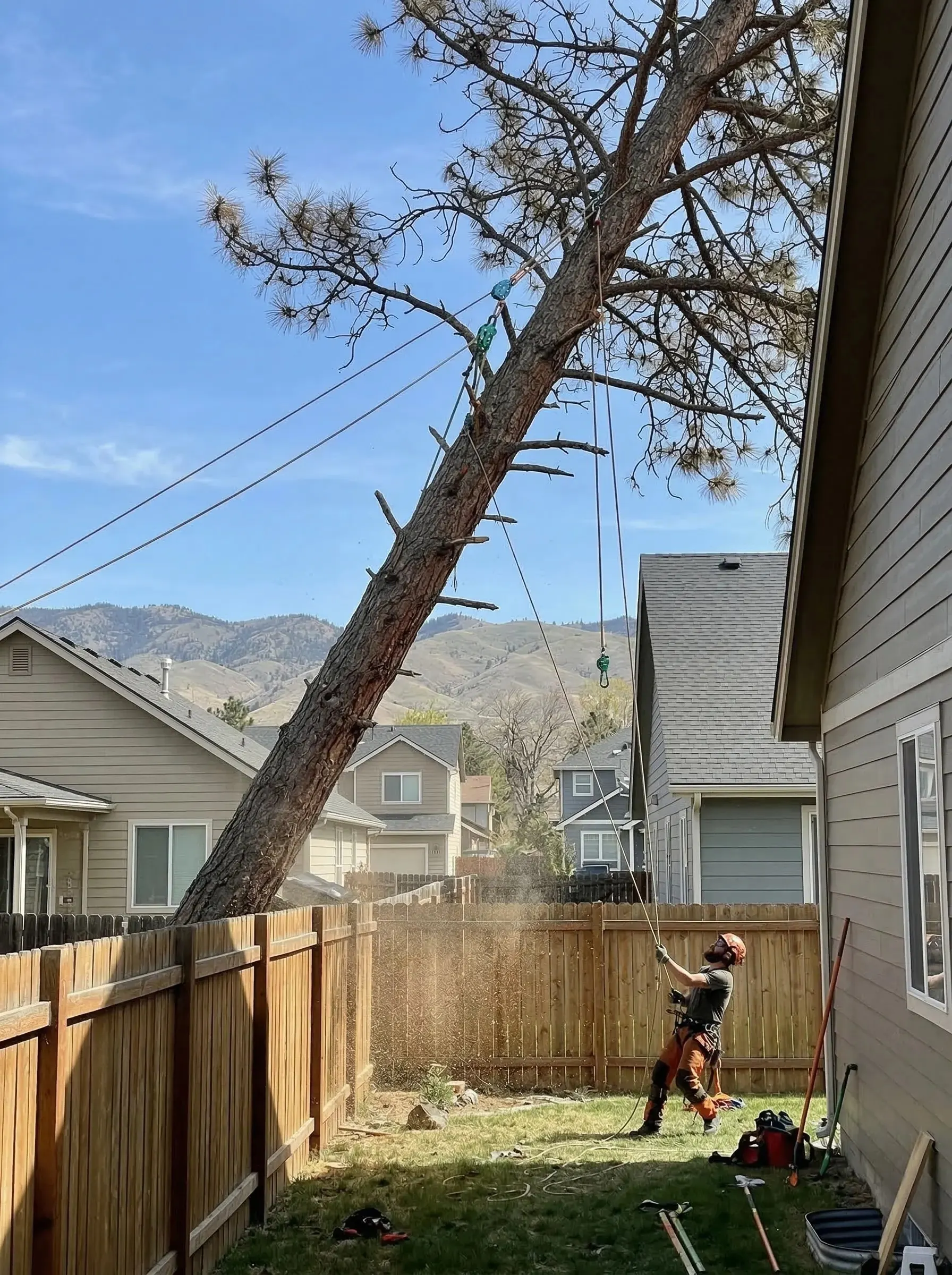
“Do I need a permit to cut down a tree in my yard?”
We get this question at least once a week. And the answer is simpler than most people think.
For trees on your own private residential property in Boise: no, you generally don’t need a permit. You can remove a tree in your yard without asking the city for permission. There are exceptions (historic districts, development projects), but for a typical homeowner on a standard residential lot, no permit is required.
The confusion comes from mixing up private trees with public trees, not knowing the historic district rules, and internet articles written for cities with very different tree ordinances than Boise. Portland and Seattle have strict tree removal regulations. Boise does not.
This guide explains exactly what the rules are for Boise and the surrounding Treasure Valley cities as of 2026, so you know where you stand before scheduling work.
In this article
Private Property: The Short Answer
If you own a residential property in Boise and the tree is on your land (not in the parking strip or right-of-way), you can remove it without a permit in most cases.
No application. No approval process. No fee. You hire a tree company, they take it down, done.
This applies to:
- Dead trees
- Hazardous trees
- Trees you simply don’t want anymore
- Trees of any size or species
- Trees in front yards, backyards, and side yards
The exceptions are below. Read them before you schedule removal.
Exception 1: Boise Historic Districts
If your property is in one of Boise’s designated historic districts, tree removal may require a Certificate of Appropriateness from the city.
The historic districts include parts of:
- North End (Harrison Boulevard Historic District)
- Warm Springs Avenue Historic District
- East End (several small districts)
- Old Boise
- South Eighth Street
What this means in practice: If you want to remove a significant mature tree in a historic district, you may need to apply through the city’s historic preservation process. The goal isn’t to prevent all tree removal. It’s to protect the visual character of the neighborhood.
How to handle it: Call the City of Boise’s Planning and Development Services department before scheduling removal. They can tell you quickly whether your property falls in a historic district and whether your tree requires approval. If it does, the process is usually straightforward for dead or hazardous trees. It gets more involved for healthy trees that contribute to the streetscape.
Our arborists can provide documentation supporting your removal request if the tree is dead, diseased, or hazardous. A professional assessment from an ISA-certified arborist carries weight in the approval process.
Exception 2: Public Trees (Right-of-Way)
Trees in the public right-of-way (the parking strip between the sidewalk and the street, or in city-owned medians and parks) are managed by the City of Boise’s Community Forestry division.
You cannot remove a public tree yourself. Even if it’s dropping leaves on your car, blocking your view, or just annoying you. Public trees belong to the city.
What the city handles:
- The City of Boise removes dead, diseased, or hazardous trees from the right-of-way at no cost to the adjacent homeowner (per the Boise Tree Ordinance)
- The city determines when a public tree needs removal
- The city selects replacement trees for the right-of-way
What you’re responsible for:
- Maintaining clearance over the public sidewalk adjacent to your property (trimming branches that hang too low over the walkway)
- Not damaging public trees (running into them with your car, cutting roots during construction, etc.)
If you want a public tree removed: Contact the city’s Community Forestry department. If the tree is dead, diseased, or hazardous, they’ll typically handle it. If you just don’t like the tree, they probably won’t remove a healthy public tree based on personal preference.
Exception 3: Development and Construction Projects
If you’re building, remodeling, or subdividing property in Boise, tree preservation requirements may apply. The city’s planning and zoning process sometimes includes conditions around preserving existing trees, especially:
- Large, significant trees on lots being subdivided
- Trees designated for preservation in a planned development
- Projects in environmentally sensitive areas
If you’re doing construction: Check with the city’s planning department early in the process. If tree preservation conditions apply, an arborist can help you develop a tree protection plan that satisfies city requirements while keeping your project on track.
What About the Rest of the Treasure Valley?
Tree removal regulations vary by city and county. Here’s a quick rundown:
Meridian
Meridian generally doesn’t require permits for tree removal on private residential property. HOA rules in subdivisions like Paramount, Lochsa Falls, and Heritage Commons may restrict removal or require approval. Check your CC&Rs before scheduling major tree work.
Eagle
Eagle has tree preservation requirements that apply to certain development activities. For routine removal on existing residential property, no permit is typically required. The Eagle Historical District may have additional considerations for significant trees.
Garden City
Garden City has specific considerations around the Boise River corridor. Trees within the riparian buffer zone may require coordination with local authorities or the Army Corps of Engineers before removal. Standard residential tree removal away from the river doesn’t require a permit.
Nampa and Caldwell (Canyon County)
Nampa and Caldwell are in Canyon County, which has its own set of regulations. Neither city typically requires permits for tree removal on private residential property. However:
- Properties near irrigation canals may have easement restrictions (coordinate with the Nampa and Meridian Irrigation District)
- Properties near Lake Lowell and Deer Flat National Wildlife Refuge may be subject to environmental regulations
- Agricultural zoning and land use changes may trigger tree-related requirements
Ada County (Unincorporated)
Unincorporated Ada County properties don’t fall under city tree ordinances. Ada County Highway District (ACHD) has requirements for trees near public roadways, but private property tree removal is generally unregulated.
Common Questions That Come Up
“My neighbor’s tree is hanging over my property. Can I cut it?”
In Idaho, you can trim branches that extend over your property line, but only up to the property line. You can’t enter your neighbor’s property or damage the tree itself. If the tree is dead or hazardous and your neighbor won’t address it, you may have legal options. An arborist assessment documenting the hazard gives you evidence to work with.
“A tree fell on my fence. Who pays?”
Generally: if a healthy tree falls due to a storm (an “act of God”), each property owner is responsible for damage on their side. If a dead or visibly hazardous tree falls because the owner neglected it, the tree owner may be liable. Document everything. Get an arborist’s assessment of the tree’s condition (was it dead or obviously compromised before it fell?). Read more about emergency tree situations.
“My HOA says I can’t remove a tree. Is that legal?”
Yes. HOA covenants are private contracts you agreed to when you bought the property. They can restrict tree removal, require specific replacement species, and dictate maintenance standards. If you disagree with your HOA’s tree policy, that’s a dispute between you and the association, not a city ordinance issue.
“I’m buying a house with big trees. Should I be worried?”
Not worried, but informed. Large mature trees add value ($10,000+ per tree in some studies) but also carry maintenance responsibilities. A tree health assessment before closing tells you what you’re inheriting: healthy trees that just need maintenance, or ticking time bombs that’ll cost thousands in the first year. It’s worth the $150 to $250 investment.
Liability: The Reason Not to Ignore Problem Trees
Even though Boise doesn’t require permits for most private tree removal, you have a legal responsibility not to maintain a known hazard. If a tree on your property is dead, visibly declining, or obviously dangerous, and it falls and damages a neighbor’s property or injures someone, you could be held liable.
The standard is “knew or should have known.” If the tree was clearly dead (no leaves for two seasons, bark falling off, large mushrooms at the base) and you did nothing, a court could find you negligent.
What protects you:
- Regular maintenance (shows you cared for your trees)
- Professional assessments when you notice problems (shows you took action)
- Timely removal of trees an arborist identifies as hazardous (shows you followed expert advice)
A professional assessment isn’t just about the tree. It’s documentation that protects you legally.
FAQs: Tree Removal Permits in Boise
Do I need a permit to remove a tree on my property in Boise?
No, not in most cases. Standard residential property owners can remove trees on their private land without a permit. Exceptions: properties in historic districts (may need a Certificate of Appropriateness) and certain development projects with tree preservation conditions.
How do I know if my property is in a Boise historic district?
Check the City of Boise historic preservation page or call Planning and Development Services. They can confirm in minutes. The main districts are in parts of the North End, Warm Springs, East End, and Old Boise.
Can I remove a tree in the parking strip in front of my house?
No. That tree is in the public right-of-way and belongs to the city. Contact the City of Boise’s Community Forestry department if you believe the tree needs removal. The city handles dead and hazardous right-of-way trees at no cost.
Does my HOA need to approve tree removal?
Check your CC&Rs. Many HOAs in Meridian, Eagle, and Nampa subdivisions require approval for tree removal, especially for larger trees. Our arborists can provide documentation supporting your removal request if the tree is dead or hazardous.
What if my tree is near an irrigation canal?
Trees within irrigation district easements may be subject to restrictions. The irrigation district (such as the Nampa and Meridian Irrigation District) may require removal or pruning of trees that interfere with canal operations. Contact the district or have your arborist assess the situation.
Do I need a permit for tree trimming in Boise?
No permits are required for trimming trees on private property. For public trees in the right-of-way, you need permission from the City Forester before doing any work. The one universal rule: don’t prune elms between April and October (Dutch elm disease risk).
Know the Rules, Then Act
The permit situation in Boise is straightforward for most homeowners. Private property, no permit needed. Historic district, check with the city first. Public tree, call the city. Make sure you're hiring a licensed tree service that knows local regulations, and check our guide on removal costs in Boise so you know what to expect.
If you’ve got a tree that needs to come down and you’ve been putting it off because you thought permits were involved, there’s a good chance you can schedule removal this week.
Get Your Free Estimateor call (986) 202-7387