
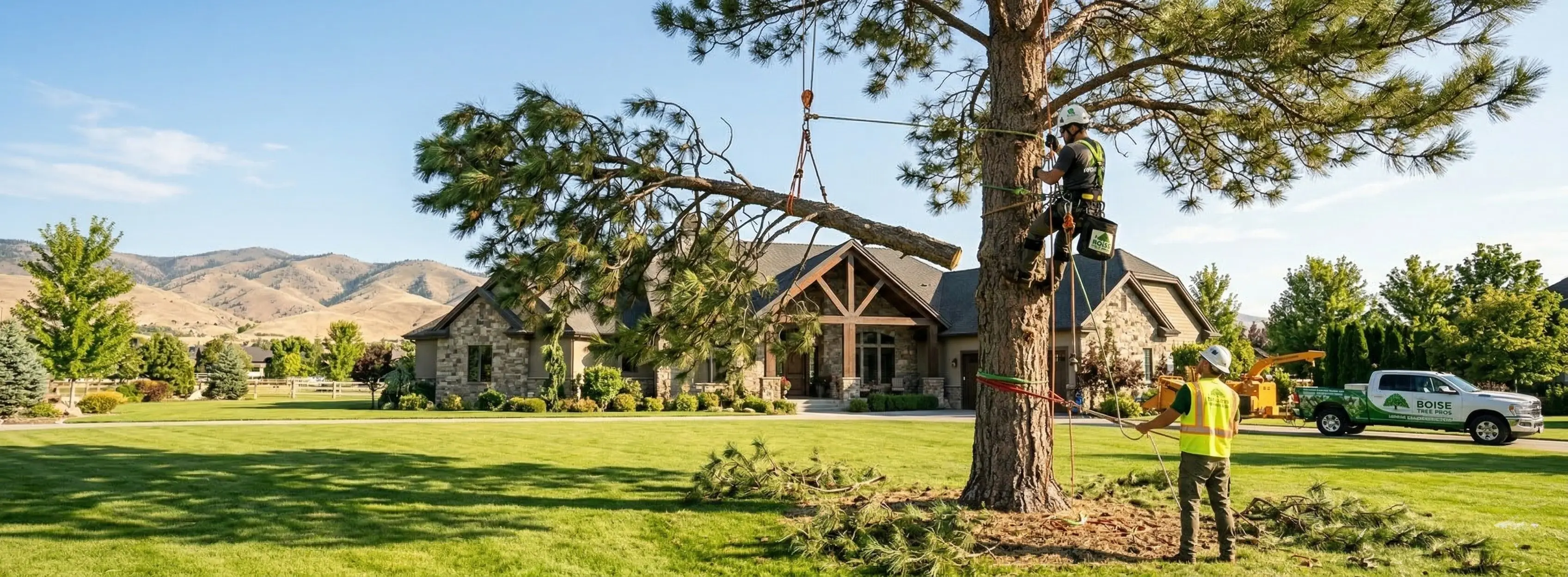
Eagle is one of the Treasure Valley's most desirable communities, about ten miles northwest of downtown Boise. Half-acre to multi-acre parcels are common here, and many of them have specimen trees that are 40, 60, or even 80 years old.
That is a lot of tree to take care of. And a lot of value to protect.
Boise Tree Pros has crews in Eagle neighborhoods on a weekly basis. Our shop is roughly 10 minutes from the heart of Eagle, and we understand the specific challenges that come with caring for trees on larger properties, in alkaline Treasure Valley soils, and in neighborhoods where landscape investment is a priority.
A healthy, well-maintained specimen tree can add $10,000 or more to a property's value. The wrong pruning cut or a delayed removal can cost far more than the service would have.
Free estimates on all non-emergency work. No pressure, no upselling.
Get Your Free Estimate | Call (986) 202-7387
Services We Offer in Eagle
Tree Trimming and Pruning
Proper pruning is the foundation of tree health and safety. In Eagle, where many properties feature mature shade trees with wide canopies, regular pruning keeps trees structurally sound, reduces storm damage risk, and maintains the look homeowners expect. We do crown thinning, deadwood removal, canopy raising, structural pruning for younger trees, and vista pruning for foothill properties with views worth preserving.
Read our full tree trimming guide
Tree Removal
Sometimes a tree has to come down. Dead, structurally compromised, encroaching on a foundation, or just in the wrong place. Eagle properties often have large trees in tight spaces, close to homes, fences, pools, and outbuildings. Our crew is experienced with technical removals that require rigging, sectional dismantling, and crane assistance. Every removal includes complete cleanup.
What to expect during tree removal
Emergency Tree Service
Windstorms, ice storms, and heavy snow loads are all part of life in the Treasure Valley. When a tree or large limb comes down on your roof, driveway, or power lines, you need a response measured in hours, not days. We provide 24/7 emergency tree service throughout Eagle and can typically have a crew on site the same day.
Emergency tree service details
Tree Cabling and Bracing
Eagle's large, mature trees frequently develop structural issues that do not require removal but do require support. Co-dominant stems, heavy lateral limbs extending over structures, and trees with a historical lean are all candidates for cabling and bracing. This is one of our most common services in Eagle, because preserving a 60-year-old shade tree is almost always preferable to removing it.
Learn about cabling and bracing
Tree Health Assessments
If you are concerned about a tree's health, planning construction near a tree's root zone, or want to know the condition of the trees on a property you are purchasing, a professional health assessment gives you answers. Our arborists evaluate root health, trunk integrity, canopy condition, pest and disease presence, and soil conditions.
Signs your tree needs an assessment
Stump Grinding
After a tree is removed, the stump remains. We grind stumps below grade so you can replant, resod, or landscape over the area. Eagle's larger lots sometimes accumulate old stumps from previous removals that were never finished. We handle those too.
Stump grinding costs and process
Common Tree Problems in Eagle
Ponderosa Pines in the Foothills
Properties north of Eagle, particularly around Dry Creek and toward Avimor, often feature native ponderosa pines. These trees are well adapted to Idaho's climate, but they face real challenges on developed lots. Construction damage to root zones is common when homes are built in native stands. Bark beetle infestations can target stressed ponderosas, especially during drought years. And wildfire risk in the wildland-urban interface means defensible space pruning (removing lower limbs, reducing ladder fuels) is not just good practice; it is a safety requirement for foothill properties.
Mature Elms
Eagle's older neighborhoods feature large American and Siberian elms that provide tremendous shade but need careful management. Dutch elm disease remains a concern in Idaho, and all elm pruning must happen during the dormant season (November through March) to avoid attracting the bark beetles that spread it. Many of Eagle's elms are also reaching an age where co-dominant stems and heavy limbs create structural risks. Cabling and bracing can often address these problems without removing a tree that took decades to grow.
Maples
Silver maples, Norway maples, and ornamental maple varieties are planted all over Eagle. Silver maples grow fast but develop brittle wood and weak branch unions. They are one of the most common species we see for emergency calls after windstorms. Regular structural pruning and weight reduction can cut the risk of branch failure significantly. One timing note: maples should be pruned in late summer to avoid excessive sap bleeding.
Cottonwoods
Along irrigation canals and in older areas of Eagle, large cottonwoods are common. These trees grow massive but have brittle wood. Cottonwoods near homes, fences, and structures need regular crown thinning to reduce wind load. Many Eagle homeowners eventually decide to remove cottonwoods that have outgrown their location and replace them with longer-lived, more structurally sound species.
Ornamental Trees in Newer Developments
Newer Eagle developments along the Eagle Road corridor and in communities like Eagle Springs feature ornamental plantings: flowering pears, crabapples, Japanese maples. These smaller trees still need professional attention, particularly structural pruning in their first five to ten years to establish strong branch architecture and prevent problems down the road.
Common Issues Across Eagle
Wind exposure. Eagle's foothill lots and open properties catch significant wind, especially during spring storms. Trees on exposed sites need regular crown thinning to reduce sail area and lower the risk of uprooting or branch failure.
Irrigation dependency. Many Eagle landscapes rely on pressurized irrigation systems. Trees that have grown dependent on irrigation can suffer stress during fall shutdowns, droughts, or if watering patterns change.
Alkaline soil. The Treasure Valley's naturally alkaline soils cause iron chlorosis in certain species, particularly red maples and pin oaks. Yellowing leaves with green veins is the telltale sign.
Construction damage. Eagle's ongoing development means trees frequently endure grade changes, root compaction, and trenching during nearby construction. The damage may not show up for two to five years.
Eagle Neighborhoods We Serve
Eagle Hills
One of Eagle's established neighborhoods with mature landscaping and larger lots. Many properties here have trees planted 20 to 30 years ago that are now reaching a size where professional management is necessary.
Banbury
Known for its equestrian properties and acreages, Banbury has a mix of native and planted trees on spacious lots.
Lexington Hills
A well-maintained community with consistent landscaping and tree-lined streets.
Eagle Springs
A newer development where trees are in the critical structural pruning phase.
Floating Feather Area
The area around Floating Feather Road features a mix of older rural properties and newer developments.
Eagle Ranch
A golf course community with carefully maintained landscapes.
Dry Creek Area
Properties along Dry Creek Road extend into the foothills and often include native ponderosa pines. Wildfire risk mitigation, defensible space creation, and native tree preservation are top priorities.
Avimor
Located at the northern edge of our primary service area, Avimor sits in the foothills with native vegetation and newer plantings.
Hidden Springs
A planned community north of Eagle with an emphasis on natural landscape integration.
Paramount (Eagle Side)
The Eagle-side portions of Paramount feature newer homes with developing landscapes.
If your neighborhood is not listed here but you are in Eagle or the surrounding area, we almost certainly serve your location. Give us a call.
Local Considerations for Tree Work in Eagle
Eagle City Tree Preservation Ordinance
The City of Eagle has tree preservation requirements that apply to certain development and construction activities. For routine maintenance on private property, no permits are typically required.
HOA Requirements
Many Eagle communities have covenants that include tree appearance standards.
Large Properties and Crane Access
Eagle's larger lots are both an advantage and a challenge. Some Eagle properties have trees that are too large or too close to structures for conventional removal.
Wildfire Risk in Foothill and WUI Areas
Eagle properties bordering the foothills sit in the wildland-urban interface, where wildfire risk is real and increasing.
Eagle Historical District
Properties in Eagle's historical district may have additional considerations for tree work.
Irrigation and Root Systems
Eagle's pressurized irrigation systems are the lifeline for most landscapes in the area. Tree roots and irrigation lines often conflict.
Tree Service Pricing in Eagle
| Service | Typical Range | Notes |
|---|---|---|
| Tree Trimming (small, under 25 ft) | $150 – $400 | Ornamentals, small shade trees |
| Tree Trimming (medium, 25-50 ft) | $350 – $900 | Most residential shade trees |
| Tree Trimming (large, 50-80+ ft) | $800 – $2,000+ | Mature elms, pines, cottonwoods |
| Tree Removal (small) | $300 – $800 | Under 25 ft, open access |
| Tree Removal (medium) | $800 – $2,500 | 25-50 ft, standard access |
| Tree Removal (large) | $2,500 – $5,000+ | 50+ ft, may require crane |
| Stump Grinding | $150 – $500 | Per stump, based on diameter |
| Emergency Service | $500 – $3,000+ | Same-day response, storm damage |
| Cabling and Bracing | $400 – $1,200 | Per system installed |
| Tree Health Assessment | $150 – $400 | Per tree or site visit |
These ranges reflect 2026 pricing for the Boise-Eagle area.
Every estimate is free.
Why Eagle Homeowners Choose Boise Tree Pros
Experience with high-value properties. Tree work on a high-value Eagle property is not just about the trees. It is about protecting the home, the landscape, the hardscaping, and the overall property value. Our crews are trained to work carefully, protect turf and plantings, and leave your property looking better than when we arrived. We carry $2 million in liability coverage on every job.
Large tree expertise. Eagle's big trees require arborists who have the skills and equipment to work safely at height. Our climbers handle 60, 80, even 100-foot specimens.
Crane capability. When a tree is too large, too close to a structure, or too compromised for conventional removal, crane-assisted work is the safest option.
Eagle-specific knowledge. From alkaline soils and irrigation dependency to HOA requirements and wildfire risk in the foothills, we know Eagle.
ISA certification and ANSI standards. Our arborists hold credentials from the International Society of Arboriculture. All pruning follows ANSI A300 standards.
10 minutes away. We are based just outside Eagle with crews in the area regularly.
FAQs: Tree Service in Eagle
Schedule Your Free Estimate in Eagle
You contact us, we schedule a visit at a time that works for you, an ISA-certified arborist walks your property and assesses your trees, and you get a detailed written estimate with clear pricing and scope of work. No pressure. No upselling. Honest recommendations from arborists who care about trees and the people who live among them.
Call (986) 202-7387 or request your estimate online.
We also serve homeowners across the Treasure Valley, including Meridian, Garden City, Nampa, and Caldwell.