
Nampa is the second-largest city in the Boise metropolitan area and the county seat of Canyon County. With approximately 110,000 residents and a location about 20 miles west of downtown Boise, Nampa occupies a unique position in the Treasure Valley. It is a city where decades-old residential streets shaded by towering elms and silver maples sit next to brand-new subdivisions built on land that was growing hay or corn just a few years ago. Working farms, rural acreages with windbreak rows, and canal-threaded neighborhoods all coexist within the city limits. That blend of old and new, urban and agricultural, creates tree care demands that are more varied and more complex than what most Treasure Valley tree companies are prepared to handle.
Our crews are in Nampa every week. We schedule Nampa jobs on a regular weekly rotation, so there is no travel surcharge, no "we'll get out there when we can" delays, and no unfamiliarity with the area. We know which neighborhoods have the biggest elms, where the irrigation canals create cottonwood problems, which subdivisions were built on former orchard land, and where the alkaline soil causes iron chlorosis in maples every summer. That kind of local knowledge comes from working in a community consistently, not from visiting it once a month.
Whether you need routine pruning on a residential shade tree, crane-assisted removal of a dying cottonwood next to a canal, stump grinding on a lot being cleared for construction, or an emergency response after a spring windstorm drops a limb on your roof, Boise Tree Pros brings ISA-certified expertise, full insurance, and the right equipment to every Nampa job.
Nampa residents get the same pricing, the same crew quality, and the same ISA-certified arborist oversight as every job we do in Boise. No exceptions.
Services We Offer in Nampa
Every service we provide in Boise is available to Nampa residents at the same pricing, with the same crew standards and the same ISA-certified arborist oversight. Our weekly Nampa schedule means efficient routing, fast turnaround, and no added travel cost. Here is what we offer:
Tree Trimming & Pruning
All of our pruning work follows ANSI A300 standards, the industry benchmark for professional tree care. In Nampa's older neighborhoods near downtown, mature trees have often gone years or even decades without proper pruning, developing dense canopies with heavy deadwood loads that become dangerous in windstorms. In newer subdivisions like Stampede and Canyon Springs, young trees need early structural training to develop the strong branch architecture that prevents problems later. Our ISA-certified arborists perform crown thinning, deadwood removal, canopy raising for clearance over sidewalks and rooflines, and structural pruning tailored to the species and the situation. Learn more about our tree trimming services.
Tree Removal
Many of Nampa's established neighborhoods contain trees that were planted 60 to 80 years ago. Some of these trees have reached the end of their safe lifespan: trunks hollowed by decay, root systems compromised by construction or canal work, major structural defects that pruning cannot fix. Our crews handle removals of all sizes, from small ornamentals crowding a foundation to massive cottonwoods towering over a house. For trees near structures, power lines, or irrigation infrastructure, we use crane-assisted removal techniques that allow us to dismantle the tree in controlled sections. Every removal includes complete debris cleanup and site restoration. Learn more about our tree removal services.
Stump Grinding
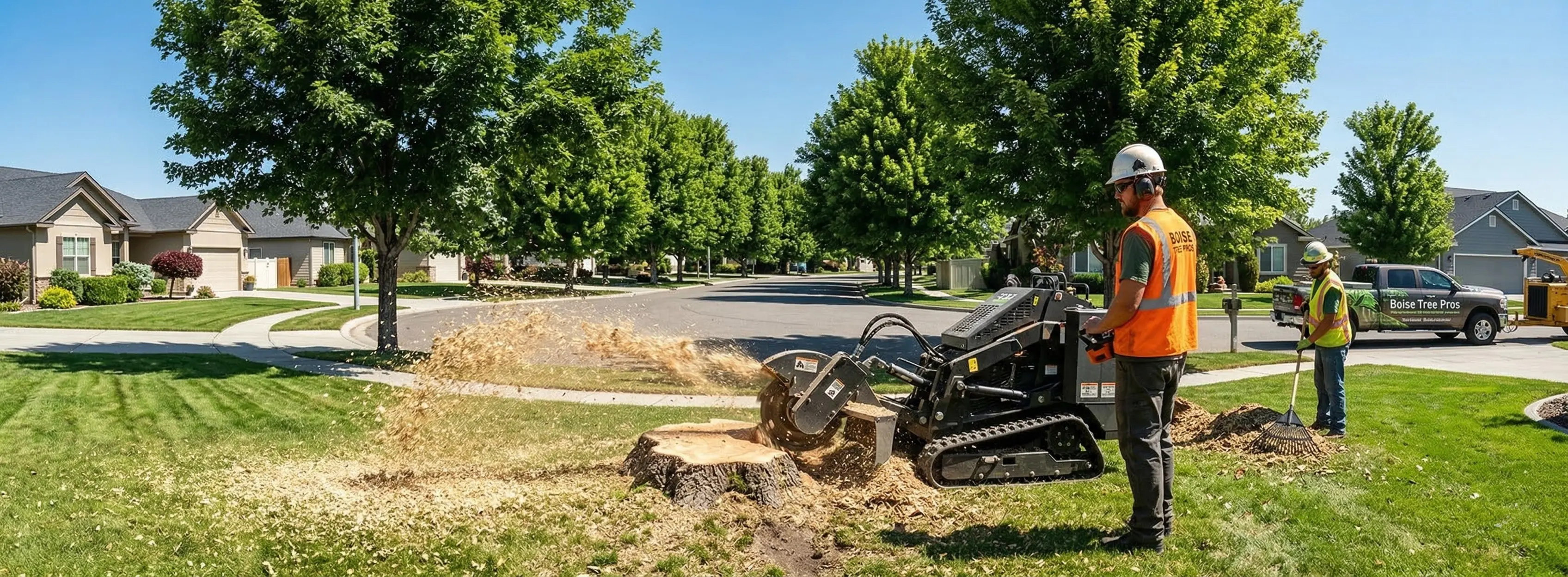
Stump grinding is in especially high demand in Nampa. The ongoing conversion of agricultural land to residential development creates constant need for lot clearing, and older properties undergoing renovation frequently have stumps from previous removals that were never addressed. Our commercial grinders remove stumps 6 to 12 inches below grade, eliminating trip hazards, preventing sucker growth, and freeing up space for new landscaping or construction. We handle multi-stump jobs on development sites and agricultural parcels where entire windbreak rows have come down. Learn more about our stump grinding services.
Emergency Tree Service
Spring windstorms hit Nampa harder than most of the Treasure Valley. The prevailing winds sweep across the open agricultural land west of the city with little to break their force, and by the time they reach the tree-lined residential neighborhoods, they are strong enough to snap limbs, split trunks, and topple shallow-rooted trees in saturated soil. Agricultural properties with unmaintained windbreak rows are particularly vulnerable. Our emergency crews are available 24 hours a day, 7 days a week, and we respond to Nampa calls with the same urgency as Boise calls. Fallen trees on structures, blocked driveways, limbs on power lines, and storm-damaged trees threatening to drop additional debris all get immediate attention. Learn more about our emergency tree services.
Tree Health Assessment
When a tree on your Nampa property starts looking wrong but you cannot pinpoint why, a professional health assessment provides answers before the problem becomes critical. Our arborists diagnose diseases, pest infestations, nutrient deficiencies, root damage, and structural weaknesses. In Nampa specifically, we frequently identify iron chlorosis caused by the area's alkaline soils, bacterial wetwood in cottonwoods growing near canals, and stress-related decline in neglected trees on parcels that transitioned from agricultural to residential use. Early diagnosis often means the difference between saving a tree with targeted treatment and losing it to a problem that went unaddressed too long. Learn more about our tree health assessments.
Tree Cabling & Bracing
Not every structurally compromised tree needs to come down. Co-dominant stems with included bark, heavy lateral limbs extending over structures, and V-shaped crotches that invite splitting can all be addressed with supplemental support systems. We install steel cables and braces that redistribute stress loads and allow valuable trees to remain safely for years beyond what their unassisted structure would permit. This approach is particularly relevant in Nampa, where large silver maples and elms in older neighborhoods often have structural defects that developed over decades of growth. Cabling and bracing costs a fraction of removal and preserves the canopy, shade, and property value that a mature tree provides. Learn more about tree cabling & bracing.
Common Trees and Issues in Nampa
Nampa's tree population reflects the city's layered history: a downtown core planted with shade trees in the early 1900s, mid-century residential neighborhoods with landscape plantings, agricultural properties with functional windbreaks and orchards, and new subdivisions with young nursery stock. Each layer brings its own species mix and its own set of challenges.
Mature Elms and Silver Maples
The oldest neighborhoods in Nampa, particularly the blocks surrounding downtown and the streets near the original town center, are lined with American elms, Siberian elms, and silver maples planted 60 to 80 years ago. Silver maples are notorious for developing included bark between co-dominant stems, a structural defect that creates a weak point prone to catastrophic splitting during windstorms. Elms require carefully timed pruning to minimize the risk of attracting the bark beetles that vector Dutch elm disease. All elm pruning in the Treasure Valley should be performed between November and March when beetle activity is dormant. If you have a large elm or silver maple on your Nampa property, regular health assessments and professional pruning are not optional: they are essential to keeping the tree safe.
Fruit Trees
Nampa's agricultural heritage means fruit trees are far more prevalent here than in Boise, Meridian, or Eagle. Apple, cherry, pear, and plum trees appear in residential yards throughout the city, many of them remnants of orchards that were subdivided for housing decades ago. Fruit trees require annual pruning to maintain productive structure, manage size, remove diseased wood, and improve air circulation that reduces fungal disease pressure. Neglected fruit trees become dense and overgrown, producing smaller, lower-quality fruit while becoming increasingly prone to pest and disease problems. Our arborists prune fruit trees to the open center or central leader structure that each species requires for long-term health and productivity.
Windbreak Trees on Agricultural Properties
One of the features that distinguishes Nampa tree work from the rest of the Treasure Valley is the prevalence of agricultural windbreak rows. Lombardy poplars, Austrian pines, blue spruces, and Siberian elms were planted along field edges and property boundaries decades ago to protect crops and livestock from Canyon County's persistent winds. Many of these windbreaks have been neglected as farms changed hands or parcels were subdivided. Dead and dying trees within a windbreak create gaps that reduce effectiveness and pose falling hazards. We handle windbreak assessment, selective removal of failed trees, and maintenance pruning to extend the functional life of the remaining row.
Cottonwoods Along Canals
The Nampa & Meridian Irrigation District manages an extensive canal network that threads through the city, and cottonwoods thrive along these waterways. These fast-growing trees can reach 80 to 100 feet, but their wood is soft and brittle. Cottonwoods shed large limbs with little warning, especially during summer storms, making them one of the most common species involved in emergency tree service calls. Their root systems can also interfere with canal infrastructure, creating conflicts with irrigation district easements. If you have cottonwoods near a canal on your property, regular crown thinning and deadwood removal are critical to reducing the risk of limb failure and canal obstruction.
Alkaline Soil and Iron Chlorosis
Like much of Canyon County, Nampa's soils tend to be alkaline, often registering a pH above 7.5. Many tree species struggle to absorb iron in these conditions. Red maples, pin oaks, and certain ornamental cultivars are particularly susceptible. The result is iron chlorosis: leaves turn yellow between the veins while the veins themselves stay green, giving foliage a distinctive striped appearance. Over time, chlorotic trees weaken progressively, becoming vulnerable to secondary diseases and pest infestations that a healthy tree would resist. Treatment options include soil amendments, trunk injections of chelated iron, and in some cases, replacement with alkaline-tolerant species. Our arborists can diagnose chlorosis, recommend the most effective treatment for the specific tree and soil conditions, and help you plan replacements when treatment is not viable.
Neglected Trees on Converted Agricultural Parcels
As Nampa expands, former agricultural land is being developed into residential subdivisions at a steady pace. The trees that remain from the agricultural era, including old windbreak rows, canal-side cottonwoods, and abandoned orchard trees, are often in poor condition after years without any care. New homeowners who purchase lots in these developments frequently inherit trees that need immediate attention: deadwood removal, hazard assessment, structural pruning, or complete removal. A professional tree health assessment is the best first step for anyone who has acquired property with existing mature trees of unknown condition. It gives you a prioritized action plan instead of guesswork.
Nampa Neighborhoods We Serve
Our crews work throughout all of Nampa, from the historic core near downtown to the newest subdivisions on the city's expanding edges. Here are the specific areas where we regularly provide tree service:
Downtown and Historic Nampa
The original core of Nampa, centered around the historic downtown district, has the densest and most mature tree canopy in the city. Large elms, silver maples, and ash trees line the older residential streets, many planted 60 to 80 years ago. This area generates the highest volume of hazard assessment and removal work, as aging trees develop structural problems, internal decay, and compromised root systems. The smaller lot sizes typical of older neighborhoods mean tree work requires precise planning to protect nearby structures, fences, utility lines, and neighboring properties.
Karcher Area
The neighborhoods along and south of Karcher Road include a mix of older residential properties and newer commercial development. Mature trees on residential lots frequently need crown thinning and deadwood removal, while commercial properties require clearance pruning over parking areas and walkways. The Karcher corridor is also where several irrigation canals pass through, bringing the cottonwood management issues that are common wherever canals and residential properties intersect.
12th Avenue Corridor
The 12th Avenue area is one of Nampa's well-established residential zones with a solid mix of mature shade trees and mid-age landscape plantings. Homeowners here regularly schedule routine pruning, health assessments, and removals of trees that have outgrown their spaces or developed structural problems. The neighborhood's central location within Nampa makes it easy to schedule and efficient to serve.
Garrity Boulevard
Garrity Boulevard is a major commercial and residential corridor. Properties along this route and in adjacent neighborhoods often have mature trees that need clearance pruning for visibility and signage, deadwood removal for pedestrian and vehicle safety, and stump grinding where older trees have been removed to accommodate property improvements or new construction. We serve both the commercial properties along the boulevard and the residential streets just off it.
Deer Flat Area
Southern Nampa transitions from residential neighborhoods to more rural properties as you approach the Deer Flat National Wildlife Refuge and Lake Lowell. Properties in this area feature a mix of residential landscape species and larger agricultural plantings. Windbreak rows, canal-side cottonwoods, and mature shade trees on multi-acre lots all require different approaches and often heavier equipment than typical residential jobs. We have the capability to handle the larger-scale tree work that these semi-rural properties demand.
Birch Lane and Canyon Springs
These established residential neighborhoods feature well-maintained properties with mature landscape trees. Common work in Birch Lane and Canyon Springs includes annual pruning, fruit tree maintenance, canopy raising for clearance, and periodic health assessments on older trees. Homeowners in these neighborhoods tend to be proactive about tree care, scheduling regular maintenance rather than waiting for problems, which is the most cost-effective approach to long-term tree health.
Stampede
Stampede is one of Nampa's newer planned communities with younger landscape trees that need establishment care and early structural pruning. The first five to ten years of a tree's life determine its shape, strength, and health for decades to come. We work with Stampede homeowners to train young trees for strong branch architecture, address transplant stress, and manage the alkaline soil challenges that affect many newly planted trees in Canyon County developments.
Lake Shore and Lake Lowell Area
Properties near Lake Lowell and the Deer Flat National Wildlife Refuge enjoy a more rural setting with larger lots and more diverse tree populations. Cottonwoods, willows, and other water-loving species thrive near the lake, while residential plantings include a range of shade and ornamental trees. Tree work in this area often involves larger specimens, longer access distances, and the need to coordinate with wildlife refuge regulations and irrigation district requirements that do not apply in the city's more urban neighborhoods.
NNU Campus Area
The neighborhoods surrounding Northwest Nazarene University feature a mix of older homes with mature trees and rental properties serving the student population. Tree maintenance on rental properties is sometimes deferred by absentee owners, which means we frequently encounter trees in this area that need significant catch-up work: heavy deadwood removal, crown restoration, and structural correction after years of neglect. We serve both the residential streets around campus and commercial properties in the area.
Local Considerations for Tree Service in Nampa
Canyon County Regulations
Nampa is in Canyon County, not Ada County, and the regulatory environment is different. Canyon County has its own rules regarding tree removal on certain lot sizes, land use requirements for agricultural properties being converted to residential, and setback regulations that can affect tree placement and removal decisions. Our team is experienced with Canyon County permitting and can help you navigate the requirements that apply to your specific property and project.
Nampa City Tree Ordinances
The City of Nampa has municipal ordinances governing trees in the public right-of-way, including requirements for maintaining clearance over sidewalks and streets. If your tree overhangs a public sidewalk, you are typically responsible for pruning it to the required clearance height. The city may also have requirements related to tree preservation or replacement during development projects. Our arborists can advise you on compliance and handle any work needed to meet city standards.
Agricultural Property Tree Management
Nampa has more agricultural and semi-agricultural properties than any other city in our service area. Managing trees on agricultural land involves different considerations than residential tree care: windbreak maintenance and replacement planning, orchard tree pruning and removal, clearance for farm equipment access, and coordination with irrigation infrastructure. Our crews have the heavy equipment and the experience to handle agricultural-scale tree work, including multi-tree removal projects, large-scale stump grinding, and complete windbreak row overhauls.
Irrigation District Rules
The Nampa & Meridian Irrigation District manages an extensive canal network throughout the city. Trees growing within canal easements are subject to district regulations, and the district may have authority to require removal or pruning of trees that interfere with canal operation or maintenance access. If you have trees near an irrigation canal on your property, it is important to understand the easement boundaries and any restrictions before scheduling work. Our arborists can help identify canal-related tree issues and coordinate with the irrigation district when necessary.
Newer Subdivision HOAs
Many of Nampa's newer subdivisions, including Stampede, Canyon Springs, and other planned communities, have homeowner association rules governing tree maintenance, species selection for replacement plantings, and the timing and scope of tree work. Before scheduling major tree work in an HOA-governed community, review your CC&Rs or contact your association. We work within HOA guidelines regularly and can provide documentation including detailed work descriptions and before-and-after photographs when your association requires it.
Lake Lowell and Deer Flat National Wildlife Refuge
Properties near Lake Lowell and the Deer Flat National Wildlife Refuge may be subject to additional environmental considerations regarding tree removal, particularly for trees that provide habitat for nesting birds or other protected wildlife. The refuge is managed by the U.S. Fish and Wildlife Service, and tree work near its boundaries should be planned with awareness of seasonal wildlife activity and any applicable federal protections. Our arborists can advise on timing and approach for tree work on properties adjacent to the refuge.
Tree Service Pricing in Nampa
Our pricing for Nampa is the same as our Boise pricing. There is no additional travel charge because Nampa is within our standard weekly service area. Here is a general reference for common services:
| Service | Typical Range | Notes |
|---|---|---|
| Tree Trimming | $150 – $2,000+ | Depends on tree size, canopy density, and access |
| Tree Removal (small) | $300 – $800 | Under 30 feet, straightforward access |
| Tree Removal (medium) | $800 – $2,500 | 30–60 feet, moderate complexity |
| Tree Removal (large) | $2,500 – $5,000+ | 60+ feet, crane-assisted, near structures |
| Stump Grinding | $75 – $400 | Per stump; volume discounts for multiple |
| Emergency Service | $300 – $3,000+ | 24/7 availability, storm response |
| Tree Health Assessment | $75 – $200 | ISA-certified arborist evaluation |
| Cabling & Bracing | $300 – $1,200 | Per system; depends on tree size and hardware |
| Fruit Tree Pruning | $100 – $400 | Annual maintenance pruning per tree |
| Windbreak Row Maintenance | $500 – $3,000+ | Depends on row length, species, and condition |
Agricultural properties with multiple trees or windbreak rows may qualify for volume pricing on larger projects. We frequently handle multi-day jobs on Nampa agricultural parcels and can provide per-tree or per-row pricing for bulk work.
Every non-emergency job starts with a free on-site estimate from an ISA-certified arborist. We assess the trees, explain the recommended work, and provide a detailed written quote. No surprises, no hidden fees, no pressure.
Why Choose Boise Tree Pros for Nampa Tree Service
Weekly Nampa service. Our crews are in Nampa every week on a regular rotation. This is not a service area we visit occasionally when it is convenient. We know the neighborhoods, the common tree species, the soil conditions, and the local regulations because we work with them constantly. That consistent presence translates into better recommendations, more efficient scheduling, and fewer surprises on the job.
Canyon County experience. Nampa is in Canyon County, and the regulatory and environmental landscape is meaningfully different from Ada County. Our team understands Canyon County permitting requirements, irrigation district rules, and the agricultural property considerations that many Nampa jobs involve. You will not have to explain the basics to us or wait while we figure out how things work on the west side of the valley.
Agricultural property capability. Unlike many tree companies that focus exclusively on residential yards, we have the heavy equipment and the field experience to handle agricultural-scale tree projects. Windbreak row maintenance and removal, large-scale stump grinding across multi-acre parcels, orchard takedowns, and complete site clearing are all within our regular capabilities.
ISA-certified arborists. Our arborists hold certifications from the International Society of Arboriculture. They have passed rigorous examinations covering tree biology, diagnosis, pruning standards, removal techniques, and safety protocols. Every Nampa job receives the same level of professional arboricultural oversight as our Boise work.
$2 million insurance coverage. We carry $2 million in general liability insurance and full workers' compensation coverage for every crew member. This protects you from liability if anything goes wrong during tree work on your property. Always verify insurance before hiring any tree company. We provide certificates of insurance on request.
Free estimates, no obligation. Every non-emergency job begins with a free on-site assessment by an ISA-certified arborist. We evaluate your trees, discuss your goals, answer your questions, and provide a detailed written estimate before any work begins. No obligation, no pressure, no sales tactics.
Frequently Asked Questions About Tree Service in Nampa
Tree removal costs in Nampa vary based on tree size, species, condition, and location. Small trees (under 30 feet) typically cost $300 to $800. Medium trees (30 to 60 feet) run $800 to $2,500. Large trees (60 feet and above) cost $2,500 to $5,000 or more, especially when crane-assisted removal is required due to proximity to structures or power lines. We provide free on-site estimates so you know the exact cost before work begins.
Yes. We regularly perform tree work on agricultural and semi-agricultural properties throughout Nampa and Canyon County. This includes windbreak row maintenance, selective removal and replanting, orchard tree pruning, large-scale stump grinding, and complete site clearing for land being converted to other uses. Our crews have the heavy equipment needed for agricultural-scale projects.
The ideal window for pruning fruit trees in Nampa is late February through early March. Trees are still dormant at this point, but spring growth is about to begin, which means pruning wounds will heal quickly as the tree breaks dormancy. Pruning during dormancy also lets you see the branch structure clearly without foliage, making it easier to identify and correct structural problems, remove crossing branches, and open up the canopy for better air circulation and light penetration.
No. Nampa is within our standard service area, and there is no additional travel charge or surcharge. Our crews work in Nampa on a weekly rotation, and all services are priced the same as our Boise rates.
Potentially, yes. The Nampa & Meridian Irrigation District manages the canal network and maintains easements along canal corridors. Trees growing within these easements may be subject to district regulations, and the district can require removal or pruning of trees that interfere with canal operations or maintenance access. Before scheduling work on trees near a canal, our arborists can help you identify easement boundaries and determine whether coordination with the irrigation district is needed.
Start with a tree health assessment. An ISA-certified arborist will evaluate every tree on the property, identifying immediate hazards, diseases, structural defects, and maintenance priorities. This gives you a clear, prioritized plan: which trees need urgent attention, which can be improved with pruning and care, and which should be removed entirely. It is far more effective and cost-efficient than guessing or tackling trees at random. We offer free on-site assessments for Nampa properties.
Get Your Free Estimate in Nampa
An ISA-certified arborist will visit your Nampa property, assess your trees, and provide a detailed written estimate at no cost and no obligation. We also serve Meridian, Eagle, Garden City, and Caldwell. Caldwell is just 12 miles west of Nampa, and we frequently serve both cities on the same day.
Request Your Free Estimate Call (986) 202-7387